Monday, April 28, 2014

Bryant, May and the Match Girls Part 2

Unlike the 1871 "strike," the 1888 walkout was not over taxes on matches.  It was concerned primarily with wages and working conditions and was clearly aimed at the management of the factory.  According to Charles Booth's survey of London, in the late 1880s and early 1890s there were over a thousand young women and girls employed in the match-making trades.  In May of 1888, more than one-fifth of the women and girls so employed earned from 4 to 6 shillings,  just over four percent earned 12 shillings or more and three-quarters of this cohort earned between 6 and 12 shillings.  These figures were not much different from those attributed to Mr Theodore Bryant in The Times of 9 July 1888, that "the girls earned on an average from 5s. a week learners to 18s. per week competent hands, and in one instance a family of three earned £2 a week between them." It is hard to comprehend Bryant and May's view that the company "tried to give ... work-people a fair remuneration."

Just what was the value of the earnings of the young women at Bryant and May?  If we take the figure of from 6 to 12 shillings, a figure which represented the earnings of 75 per cent of the group we are looking at, and consider it in terms of buying power today, it would equate to a figure of between £29/16s and £59/12s.

Clearly the company saw its first responsibility to its shareholders and evidence for this can be seen in the  enormous growth in the value of the shares, more than 300 percent in less than five years, as well as a dividend rate that regularly exceeded 20 percent. 


Match Girls at Work - 1888
For those on the lowest rate of pay, 4 shillings, even the most basic necessities of life were expensive. Bread, for a two kilogram loaf, cost around 3d a loaf and beer was more than 1d a pint.  Beer was an important part of the diet since water in many of the areas was only available from a standpipe and was always of questionable purity and even more questionable quality. For those few who might have smoked cigarettes, rather than the ubiquitous clay pipe, W.D. and H. O. Wills newly launched Woodbines could be purchased at a price of 5 for a penny.  Strong and rough, like the East End workers themselves, they were to become known colloquially as "gaspers."  

The common work-day was ten hours long and for most of that time the young women were on their feet cutting in half the long strips of wood, both ends of which had been dipped into a compound of chemicals to create the match-heads. The cut matches were then packed into boxes. The work was not steady as the demand for matches was seasonal with the greatest number of matches being required during the colder months.  Since many of the women and girls were unemployed in the summer months they augmented their incomes through employment in jam factories or, in the late summer and early autumn through going hop-picking.


Girl At Work at Bryant and May 1888
A number of well-known and influential individuals took up the cause of the match workers, the most outspoken and prominent was Annie Besant,  a socialist,  writer and  women's rights activist.  In her Autobiography she tells how she interviewed some of the match girls and "got lists of wages, of fines, &c."  The information was published as "White Slavery in London" in The Link, A Journal for the Servants of Man a left-wing, half-penny weekly. In the article she points out that the workers started at 6.30 in the summer and 8.00 in the winter. Work concluded at 6.00 in the evening and workers were allowed half an hour for breakfast and an hour for dinner. 


Annie Besant
In some departments a fine of 3d . is inflicted for talking. If a girl is late she is shut out for 'half a day', that is for the morning six hours, and 5d. is deducted out of her day's 8d. ...A very bitter memory survivies in the factory.  Mr. Theodore Bryant, to show his admiration of Mr. Gladstone and the greatness of his own public spirit, bethought him to erect a statue to that eminent statesman.  In order that his workgirls might have the privilege of contributing, he stopped 1s  each out of their wages, and further deprived them of half-a-day's work by closing the factory, 'giving them a holiday'. ('We don't want no holidays', said one of the girls pathetically, for - needless to say - the poorer employees of such a firm lose their wages when a holiday is 'given'.) 
Gladstone Statue at Bow Church
Over the poor conditions and underpayment, over the fines and long hours, there hovered the spectre of disease.  The young women ate at their workbenches where the lucifer matches were made thus being exposed, even as they ate, to the fumes from the white phosphorous with which the matches were tipped.  Even as late as 1888 Bryant and May were still using this deadly substance despite its effects having been well known since the  late 1830s.

The 1888 strike itself was provoked by the firing of one of the match girls but the tinder of dissatisfaction had been smoldering for some time.  Whether the term "sweatshop" was used or not (in general it was applied to clothing manufacturing), Bryant and May ran one in their factories.  The environment was dangerous and certainly unhealthy.  The pay was low, the hours long and the employees were victims of abuse and without recourse. On the 23rd of June, The Link published "White slavery in London," an article by Annie Besant in which she accused Bryant and May of the worst sorts of practices.  
Born in slums, driven to work while still children, undersized because underfed, oppressed because helpless, flung aside as soon as worked out, who cares if they die or go on the streets, provided only that the Bryant and May shareholders get their 23 per cent., and Mr. Theodore Bryant can erect statues and by parks?  Oh if we had but a people's Dante, to make a special circle in the Inferno for those who live on this misery, and such wealth out of the starvation of helpless girls.
The East London Observer, a weekly paper which was, according to L. Perry Curtis, one of the "small local papers that catered mostly to the commercial or small-business classes in Tower Hamlets and environs" chose to use the term "sweated" in its edition of 30 June 1888, in which it raised the question regarding the girls, "Are they Sweated?"   In the article it reported that Theodore Bryant was threatening legal action against Annie Besant.  On the same day, Besant wrote in The Link that she had been informed that the girls were being bullied in an effort to find out who had provided the information that had appeared in "White Slavery in London." In the same piece, she challenged Bryant and May to sue her for libel in order to "disprove my statements in open court ... instead of threatening to throw these children out into the streets."

Besant continued to goad Bryant and May.  A week later she noted that there had been no sign of legal action and claimed that three girls believed by the company to be her informants had been dismissed.  At this point, although Bryant and May claimed that only one girl had been dismissed and that was for matters unrelated to the complaints, 1400 girls walked out.  The issue escalated with meetings being held through the first weeks of  July.  Although Besant's own writings tend to place her at the centre of events, Louise Raw, in Striking a Light, suggests that this was not the case and that, in effect, she came late to the struggle and left early. As for the threats to take legal action against Besant, these came to nothing.  Indeed, the whole counter-offensive launched by Bryant and May seems to have little or no effect on either the strikers or their supporters and if anything, their threat to bring in workers from Scotland hardened the stance of the women.

Whatever the case, Bryant and May offered to rehire the sacked worker but the striking women must have felt a sense of power when they saw how quickly Bryant and May responded in order to keep their factories working.  Even so, the women were still out of work and the company continued to play "hardball." The London Trades Council then took up the cause of the match workers and with the concurrence of the Girls' Strike Committee approached Bryant and May offering its services to bring the matter to settlement. Interestingly, the first meeting between the LTC and the directors of the company which apparently did not include any representatives from the Girls' Committee appears to have been met with a complete unwillingness to negotiate.  According to the East London Observer for 21 July, "The deputation urged the points on behalf of the strikers, to which the directors replied seriatim, and repeated their previous statements that they paid full current wages, and had no desire to burden their work-people."  The meeting lasted for an hour and three quarters and achieved no satisfactory resolution. 


Match Girls and Match Seller
The following day there was another meeting at which, in addition to the LTC representatives the Girls' Strike Committee was present.  By now the directors of the company had undoubtedly had time to reflect on their position and would have realised that the strikers were prepared to fight for what they believed were their rights.  After considerable discussion and debate there was agreement on a settlement.  This included the abolition of fines and the stopping of deductions for a variety of supplies, changes in the manner of payment and access, in the case of grievances, to the managing directors without going through the foremen. As well, Bryant and May agreed to take back all of the strikers including the so-called ringleaders and "said they would, as soon as possible, provide a breakfast-room for the girls so that the latter will not be obliged to get their meals in the room where they work."  And, in what was possible the greatest concession, they "expressed a strong wish that the girls would organize themselves into an union so that future disputes, if any, may be officially laid before the firm."

Surely the company could not have offered a greater capitulation and, not surprisingly, the strikers unanimously accepted the terms.  The strike was over. The London Daily News, on 18 July, complimented Bryant and May for admitting "in the most handsome way that the girls were right, and that they had themselves been misled by some of their officials." The statement, of course, attempted to remove the blame from those who were most responsible, the directors of the company.

Clippings from The Link related to the 1888 strike, and including Annie Besant's "White Slavery in London," can be found by clicking here.

Friday, April 25, 2014

Bryant, May and the Match Girls

When I started to explore the match girls' strike of 1888, I was not surprised to learn that there was a long history of problems in the match trade, nor that even after the strike there were issues that were not fully addressed.  As a result rather than just one blog, the exploration has extended over three.  In the first one, I will look at the origins of the strike and the background of the match trade beginning with the events of 1871.  The second blog will address the events of the 1888 strike itself, and in the final blog I intend to talk about the failure of Bryant and May, the manufacturers, to address a number of issues and, perhaps more to the point, the way in which they attempted to evade responsibility. 

And will the match trade die?
Then thirty thousand working girls
Will know the reason why.
Daily News (25 April 1871)

The Background

"The East End is labor and poverty, chained together by the curse of our time — servitude; the City is the usurer who sells labor and pockets the profit."
J. H. Mackay, The Anarchists

It was a wet, cold and dreary July in London in 1888,  The temperature barely crawled to the average of 72 degrees Fahrenheit on the 23rd and only seven days that month made it to a chilly 70 degrees.  On the 12th of the month there were reports of snow in the suburbs of the Metropolis but whatever the weather, it did not deter those who followed the tennis. In what must have seemed a world away from the East End, at Wimbeldon, Ernest Renshaw defeated Herbert Lawford in three straight sets to win the Gentlemen's Singles and Lottie Dod took out the Ladies' Singles, also in straight sets.   It was still a month before the East End murders were discovered and the name of Jack the Ripper was to become synonymous with the gruesome murders which struck fear amongst residents, particularly women, in the East End. 

It was from the East End that most of the young women who were to "down tools" in 1888 and walk out of the Bryant and May match factory came. The East End was often seen, and quite rightly, as among the worst sections of the great metropolis.  Sylvia Pankhurst, some years later, referred to it as "that great abyss of poverty," and in The Bitter Cry of Outcast London, the Reverend Andrew Mearns described the living conditions in which many of the match workers lived as:
pestilential human rookeries ... where tens of thousand are crowded together amidst horrors which call to mind .. the slave ship. To get into them you have to penetrate courts reeking with poisonous and malodorous gases arising from accumulations of sewage and refuse scattered in all directions. ... Where there are beds they are simply heaps of dirty rags, shavings or straw, but for the most part these miserable beings huddle together upon the filthy boards.
A London Slum
Out of the stinking, pestilential slums and out of Bryant and May's match factory came the girls and women marching for better conditions and marching into history.

Not that it was the first time those in the match industry had marched.  Seventeen years earlier several thousand match workers, mostly girls between the ages of thirteen and twenty, marched from the East End to the Parliament at Westminster to oppose a threatened tax on matches.  The Illustrated London News effectively made the point that this was not something entered into lightly by the East-Enders.
The poor matchmakers, women and children, turned out in large numbers, and may be said to have groped their way into the unknown regions of Westminster to assure some great man, of whom they had heard, that he was going to starve them, and to beg him not to do so.

Several hundred of the marchers actually made their way into Westminster-hall in an attempt to present a petition to the House of Commons.  The march was generally good-natured and was easily dealt with by the police.  The difference between this march and the later match girls march, was that in 1871 the march had the approval, tacit if not overt, of the employers  who were to be hardest hit by the proposed levy. According to the Daily News, in the Police Court
At Bow-street one of the men who had been apprehended stated that a well-known firm of match manufacturers had contributed a band and flags to the demonstration,

 and The Times "Police" report quoted  a witness who identified the firm as Bryant and May.

In reading the various reports, one almost feels as if The Times, was reporting a different march.  It described the demonstration as "attended with riots in the East-end of London and a riotous assemblage around the Houses of Parliament." But for The Times, which was in many respects an organ for the conservative upper middle classes, any march by the lower and labouring classes would probably have been seen as a threat to social stability - even when it was supported by those manufacturers opposed to the match tax.

Between the 1871 "strike" and the 1888 walkout, there were at least three strikes; so, despite the claims of management that there had been peace at the factory until the socialists "forced" the strike, such a claim was, at best, dubious. Besides, from 1873 onward, Great Britain was in the grip of a major depression which was generally considered to have lasted until the middle of the last decade of the century and although the price of matches fell during this period, so too did wages.  Louise Raw points out that by 1888 Bryant and May "had become such a powerful monopoly that they were able to pay wages which were lower than they had been a full 12 years earlier." 

But besides low wages in the industry and the maltreatment of the workers, there was the risk of that most horrible disease, phosphorus necrosis of the jaw or Phossy Jaw as it was more commonly known. At best this could lead to permanent disfigurement and at worst to a slow and painful death.


Phossy Jaw
A brief article in The Journal of Oral and Maxillofacial Surgery notes:
The infamous “phossy jaw” that created an epidemic of exposed bone osteonecrosis exclusively in the jaws began around 1858 and continued until 1906, with only a few cases appearing since that time. This epidemic of osteonecrosis produced pain, swelling, debilitation, and a reported mortality of 20% and was linked to “yellow phosphorous,” the key ingredient in “strike-anywhere” matches. In match-making factories, workers called “mixers,” “dippers,” and “boxers” were exposed to heated fumes containing this compound. Related to the duration of exposure, many of these workers developed painful exposed bone in the mouth.
It might be supposed that the information on this foul disease might have been confined to medical journals of the day, but as early as 1852, Charles Dickens was writing about it, and its effect on those in the matchmaking industry, in Charles Dickens' Household Words for May of 1852. One of his informants told of her clothes and hands glowing at night.

Much of the change between 1870 and 1888 centered around the key figure of Wilberforce Bryant.  The son of one of the firm's founders, by 1861 he was managing the Bow Street plant. Although the business was started as a private concern, in June of 1884 it became a limited company with capitalization of 300,000 pounds in 60,000 shares and an additional 150,000 pounds was offered in debentures for public subscription. Thomas A. B. Corley, in his biographical sketch of Wilberforce Bryant notes that 
The financial press was soon condemning the firm for its annual reports --'the most cynically meagre and imperfect documents published by any board in the country;--and fir its insider dealings to rig the share prices for its own ends (Financial News).
Clearly the company was not in good odour in the 1880s. and was being run by a narrow-minded, conservative senior director.

To read Charles Dickens' article "One of the Evils of Matchmaking"  in Household Words for May of 1852, click  here.

Monday, January 06, 2014

Conquering the Channel

A Caricature of Captain Matthew Webb (Vanity Fair, 9 October 1875) shortly after his conquest of the English Channel

With the failure of J B Johnson's attempt on the English Channel, interest in the possibility of a successful crossing grew. By the middle of the '70s, it had reached fever pitch and another attempt was soon to be made. This time the swimmer was Matthew Webb or, as he was more commonly styled, Captain Webb. Webb had read of Johnson's earlier attempt and obviously felt that he could succeed where his predecessor had failed. At the time, Webb was serving as captain of the steamship Emerald.

The young Matthew Webb had come to the sea through childhood stories of adventure under sail and, at the age of twelve, he left home to sign on as a merchant seaman. He spent three years aboard the training ship, Conway where he was already noted for his staying power as a swimmer.  Kathy Watson, in her biography of Webb, The Crossing, quotes one of his colleagues aboard the Conway,
We thought very little of him as a swimmer but admired his staying power.  He could swim about for an hour without putting his foot to the floor, although in a race he was nowhere.
The water apparently held no fear for him and even as a trainee,  as Watson points out, he won a silver pencil for rescuing another boy who had fallen overboard. Rescuing, or at least attempting to rescue, people from drowning was to have a significant impact on Webb's life.  In 1873, as second mate aboard the Cunard Ship, Russia, travelling from New York to Liverpool the 25 year old Webb jumped overboard in an attempt to rescue a seaman who had fallen from the rigging.  Unfortunately, the sailor was not seen again and only his cap was recovered.  After half-an-hour in the water, Webb was brought back on board the steamer.  For his bravery he was awarded both the silver medal of the Royal Humane Society and its newly created Stanhope Medal. Sadly, in 1989, all of Webb's medals, including the Stanhope and the Royal Humane Society Medal were sold at auction to a private collector for  £12,650.
The man with his medals
Webb's first attempt to swim the English Channel  was made on 12 August 1875.  At the time he was, according to the volume, Swimming, in the Badminton Library,
5 ft. 8 in. high, measured 43 in. round the chest, and weighed about fourteen and a half stone. ...During his training he once swam out to the north-east Varne Buoy, which is more than half-way across the Channel, and also from Dover to Ramsgate, about eighteen miles, in 8 hrs. 45 mins., as well as in the Thames from Blackwall to Gravesend in 4 hrs. 52 mins.
The Channel attempt was widely covered in the newspapers of the day with many of them relaying reports from their local correspondents.  At just before five in the evening, Webb was liberally coated in  a yellow fatty oil obtained from porpoises.  Fair weather and calm seas were expected and at just a minute or two before five the swimmer entered the water.  According to the London Daily News, "he commenced his journey amid a round of cheers."  Despite expectations of fine weather, a breeze had sprung up and the water was beginning to roughen.

Webb set off briskly, covering the first quarter mile in ten minutes using a breast stroke, but the weather began to turn and just before midnight, after swimming about thirteen and a half miles in just over 6 hours and 48 minutes and  despite feeling "warm and quite well," he decided not to continue saying that "it was impossible for any mortal man to swim as far again in such a sea."  According to The Times, in the opinion of those accompanying him, "had the weather been fine he would have succeeded in reaching the French coast."

Webb and his team watched the weather carefully and planned another assault on the Channel.  Monday, 23 August looked good for a midnight departure but the weather forced a further delay until the following day. At just before one in the afternoon, Webb dived from the end of Admiralty Pier and headed for France.

Admiralty Pier, Dover
Using his slow breast stroke, he made such progress that the lugger which accompanies him across as before, although it had all sail set, had to put out oars and row to keep up with him.   Two rowing-boats follow him with the referees and a young man who is ready at any moment to plunge into the sea to render Captain Webb any assistance he may require.
Swimming at 23 strokes to the minute, Webb made good progress initially but the length of time in the water, the coldness, the stings of jellyfish and the tide which forced him to swim a much greater distance than he had anticipated all began to tell on the swimmer.   After just over 21 hours and 45 minutes, the exhausted swimmer dragged himself ashore in France. Kathy Watson describes the moment when,
Exhausted, delirious, his face encrusted with salt, one eye blind from the waves, his body rigid and greasy like a lump of cold wax, Webb stood, stumbled and fell, lifeless, into the waiting arms of his friends.
Webb recovered quickly and within days was being lionized.  Early in September he visited the Baltic, the Stock Exchange and attended the Covent Garden Promenade Concerts.  Subscription lists were started for him and he was an honoured guest at the officers' mess of the Royal Artillery.  Although not a good speaker (he was described as speaking in a "brief, genial but not too fluent manner which is usually associated with sailors") he strongly advocated the teaching of swimming, telling one group according to the Manchester Times that
he considered it very important that more people should be able to swim than at present: and if in swimming across the Channel he had caused people to think more of teaching their boys to swim he should be well satisfied with what he had done.
It didn't take long for the enterprising book market to cash in on Webb's fame.  Within days The Channel Feats of Captain Webb and Captain Boynton was on the market.  Only 64 pages in length, it featured  "a dashing picture of Captain Webb bravely breasting his way across the Channel." Reviewed in The Penny Illustrated Paper and Illustrated Times of 11 September 1875, it was described as a "seasonal little book" and one which "provides the reader with a complete account ... as well as a brief memoir of Webb and Boynton."

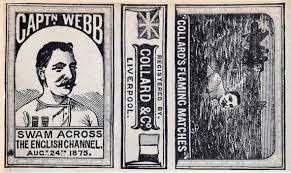
Webb's face was soon well known throughout the length and breadth of the land. Here was a real hero, a conqueror of the most elemental forces. His image appeared on mugs and cups, on matchboxes and other innumerable forms of ephemera.


Ephemera

As if that was not enough, advertisements featuring his image appeared on walls and song sheets praising his valour and his accomplishments were available.

"Ghost" sign on a wall

Song Sheet

The chorus to the 1875 song, "Captain Matthew Webb or Swimming from England to France," seemed to capture the public approbation engendered by the feat.
Hurrah! for Captain Matthew Webb, the hero of the age,
His noble name shall always fill a space in History's page ...
For the next few years Webb was in and out of the news.  Various swimming exhibitions and competitions both in England and in the United States either failed to materialize or were less satisfactory than the swimmer might have wished.  finally, in July of 1883, just short of eight years after his magnificent Channel crossing, he made one final attempt to regain the stature he so desired.  For a fee of $10,000 he undertook to swim the rapids and whirlpool at Niagara Falls.  The funds were put up by various railway companies in the hope that such an attraction would draw crowds to the scene requiring them to run special trains.

Despite attempts to discourage him, Webb entered the water from a small boat.  According to Reuter's,
on entering the rapids [he] was almost turned over by the force of the water.  He swam the rapids, however with great determination, being now and again caught sight of by a few of the spectators.  When last seen he was entering the whirlpool, and at first appeared to be doing well, but very shortly afterwards threw up his arms and disappeared.
When Queen Victoria heard the news, she wrote in her Journal on the 27th of July, "the celebrated swimmer, Capt: Webb was drowned while trying to swim across the rapids at Niagara, very shocking."

The very next day, July 28th, His body was recovered from the river.  It was Captain Webb's last swim.

 Despite his latter years, nobody would ever be able to take away from Matthew Webb the glory of having been the first to swim the English Channel.  Over the years many others attempted to duplicate his feat, but it was not until 36 years later that Thomas William Burgess succeeded in swimming from Dover to Gris Nez in 22 hours and 35 minutes.  In the years between the two successful swims, there had been more than eighty attempts; all of which ended in failure. Certainly for the 36 years between Burgess's and Webb's crossings, the Badminton Library's volume on Swimming was not wrong when it said Webb's triumph was "the greatest authenticated long-distance swim in the sea without any artificial aid."

While Captain Webb may have faded from popular memory, only to be known to Channel swimmers and historians, he did manage to reappear from time to time. In 1940, John Betjeman (later to be appointed Poet Laureate by Queen Elizabeth II) wrote "A Shropshire Lad," in which he has Webb's ghost swimming back to his home in Dawley along the canal. In a completely different context, the American cartoonist and creator of the comic strip, "Pogo," Walt Kelly briefly paid tribute to the swimmer in his strip in 1968.


The full "Pogo" comic strip can be seen by clicking here.
To hear "Tom O'Bedlam's reading of John Betjeman's "A Shropshire Lad," click here.

Sunday, January 05, 2014

The Challenge of the Channel

With the growth of leisure time in the later years of Victoria's reign, the variety of sports both for participants and spectators grew rapidly.  Men and women competed against time, the elements and one-another. Much was conquered but much remained and in 1870 the English Channel retained its mystique and its reputation as being unconquerable - at least by swimmers. There was something special about this fascinating body of water.  It was, after all, what divided England from the European continent and was, to use William Shakespeare's image, part of "a moat defensive to a house/Against the envy of less happier lands."

This royal throne of kings, this sceptred isle,
This earth of majesty, this seat of Mars,
This other Eden, demi-paradise,
This fortress built by Nature for herself
Against infection and the hand of war,
This happy breed of men, this little world,
This precious stone set in the silver sea,
Which serves it in the office of a wall
Or as a moat defensive to a house,
Against the envy of less happier lands,--

                                          William Shakespeare, "ing Richard II, Act 2 scene 1

The English Channel had always been part of the great defensive net around England and while it was regularly crossed by boat, experience had shown that it was a bulwark against invasion. But by the last quarter of the nineteenth century it was becoming easier to cross.  The first balloon passage took place as early as January of 1785 when  Jean-Pierre Blanchard, with the American, Dr. John  Jeffries, navigated from England to France in about 2½ hours.

  Thirty years later, in March of 1815, the steamship Élise in a harrowing seventeen hour crossing conquered the Channel for steam. But it was not until 1872 that the first recorded attempt to swim the English Channel took place.  The swimmer, J B Johnson, lasted for only three minutes more than an hour before abandoning the effort.

Johnson was a professional swimmer based in Leeds who came to prominence in 1871 when he won the swimming championship at the Welsh Harp Lake at Hendon in the teeth of a driving hailstorm and in front of a crowd of three or four hundred spectators. The Times described him, at the time, as "undoubtedly the best swimmer [in] England." Johnson had already attracted some interest and attention in the press when, a few days earlier, he had leapt from London Bridge apparently to rescue a gentleman who had fallen from a Thames Steamer. According to The Badminton Library volume on Swimming, this "afterwards turned out to be a mere exhibition. Johnson dived to rescue a drowning person, the said 'drowning person' being his brother Peter, who was nearly as good a swimmer as the famous J. B., and a capital stayer under water."

In August of the following year, Johnson attempted to swim the English Channel.  He clearly realised the value of publicity and a few days before his attempt had posted placards around Dover from where the swim was to originate. The placards announced that the "hero of London-bridge and champion swimmer of the world" would swim from England to France.  Such a feat was generally deemed to be impossible, although there were stories of three escaped French political prisoners attempting to swim to England.  Two were supposed to have completed the swim, one of whom died almost immediately thereafter while the other survived and lived in Dover for a number of years.  But the attempt by Johnson was not to be one of rumor or half-truth; it would be thoroughly documented.

At the time, Johnson was twenty-four years old and a superb physical specimen as well as being captain of the prestigious Serpentine (swimming) Club in London.

Johnson's attempt came about as a result of a bet placed in Leeds, his home town, at odds of 1000 pounds to 30 pounds, a wager which was quickly doubled. Having already made his mark as a swimmer, he must have realised that a successful crossing of the Channel would raise him even further in the eyes of both the public and the swimming fraternity. Always aware of the power of publicity, in addition to the placards which had been placed around Dover, Johnson hired the brass band of the Royal Surrey Zoological Gardens to play at the start of his swim. A steamer, the Palmerston, was engaged to accompany him.  He was cheered by a crowd estimated by the Times's correspondent at thousands  when he dove into the water from the steamer at 10:40 am on Saturday, 24 August. After an hour, however, it became clear he would be unable to go on.  He took some port wine at 11:20 and again at 11:30 while still in the water, but by 11:45 he was out of the water and on the deck of the steamer.

According to the Times, when he was pulled aboard, his legs were numb from the thighs down and he was suffering from hypothermia to such a degree he was even unable to drink some of the beef-tea which was proferred. Nonetheless, always the showman, when the Palmerston arrived at Calais at 3:00 pm, he, and his brother who was accompanying him, "dived into the water, one from each side of the boat, and delighted the spectators anxiously awaiting his arrival with various specimens of aquatic skill."

While perhaps not achieving the fame he sought, Johnson certainly was the subject of much adulation.  Despite his failed attempt at the Channel, a popular song, "I wish that I could swim like J. B. Johnson, was soon being heard.

The other day he tried to swim,
To Calais right from Dover,
The task seem'd easy unto him.
When seven miles were over,
Right through the sea, he seem'd to fly,
He stop'd, tho' not through failure,
When I can swim, you'll see I'll try,
To go right to Australia.

Two of the verses refer to his feat at London Bridge and his failed attempt on the Channel, neither of which seemed to, in any way, to lower his popular appeal.  But it was not until three years later that the English Channel was finally conquered, not by J. B. Johnson, but by Captain Matthew Webb.

To see the whole song, I wish that I could swim like J. B. Johnson, click here.

Friday, December 20, 2013

The Ashes

The Ashes
Cricket may well be the most English of games, and there is certainly no more fiercely fought series than the clashes between England and Australia. The series is affectionately known, in both countries, as "The Ashes" and is usually fought out every two years.

It was the Northern summer of 1882 and although England had lost in its previous Australian tour, it had never been defeated by the "Colonials" on home soil.  Although sometimes referred to as the first Ashes test, the 1882 match was a single match played over two days and was only later elevated to the status of a Test.

While "The Ashes" was an indirect product of England's defeat, it was not in existence at the time of the match. As to the game itself, from the beginning it looked to be England's for the taking.  In the first innings on a rain soaked pitch Australia was bowled out for an unimpressive 63.  With England in to bat, Australia managed to hold their proponents to just 101. The outstanding bowler for Australia was Fred (The Demon Bowler) Spofforth who took seven wickets for 46 with 147 deliveries. Evidence of the excitement generated by the match could be seen in the attendance which, during the course of the first day's play, rose from 10,000 to around 22,000.

According to the Cricket historian, Bernard Whimpress,
On the sloping embankment close to the chains people were standing 20 deep all round, and further back on the terraces the crowd was equally dense, while in the stands there was not a vacant seat.  The roofs of the dingy brick houses surrounding The Oval also bore eager spectators.
The match at the Oval
The second and final day of play saw Australia, with its meager score of 101, leaving England needing only 85 runs to win.  Tempers had, however, become a bit frayed when W.G. Grace took one of the Australian wickets in what many considered to be a less than honorable manner. According to Wisden's Almanack, that great Bible and guide to all things Cricket,
At 114 Jones was run out in a way which gave great dissatisfaction to Murdoch and other Australians. Murdoch played a ball to leg, for which Lyttelton ran. The ball was returned, and Jones having completed the first run, and thinking wrongly, but very naturally, that the ball was dead, went out of his ground. Grace put his wicket down, and the umpire gave him out. Several of the team spoke angrily of Grace's action, but the compiler was informed that after the excitement had cooled down a prominent member of Australian eleven admitted that he should have done the same thing had he been in Grace's place. There was a good deal of truth in what a gentleman in the pavilion remarked, amidst some laughter, that Jones ought to thank the champion for teaching him something.
"W. G."
While the gentleman in the pavilion may have been amused, the Australians were not. Surely, if Spofforth or, for that matter, any of the Australian players heard those remarks they would have fumed at the condescension which would have been all that it took to inflame the Australians. Needing 85 runs to win, England had reached 51 with only three wickets having fallen.  Famously, Spofforth announced to the Australians, "This thing can be done."  And done it was, in no small measure due to the bowling of "The Demon."  In the end, Australia won by 7 runs with Spofforth having taken 7 wickets in each of the two innings for 44 and 46 runs respectively.  It would be ninety years before another Australian bowler, Bob Massie, matched or surpassed this.  Massie bowled 16 for 137 at Lords  in the second test of the 1972 Ashes series which ended in a draw with each side winning two of the matches.

Fred (The Demon Bowler) Spofforth
Even The Illustrated London News was forced to to admit, although somewhat reluctantly, that while the Australian victory was "not a great triumph," it was still "one of which the Colonial Eleven may well be proud."

Many English sports lovers  must have been aghast not only at the English team's loss, but at the sheer effrontery of the Australians daring to win on English soil.  After Australia's win, an obituary appeared in The Sporting Times.  It read


The story might have ended there had it not been for two events.  First, the English captain of the side playing the 1882-83 series in Australia, Ivo Bligh, later Lord Darnley, announced that he intended to "regain those ashes."  As a result, the series became known in England as the quest to regain the Ashes.

Ivo Bligh
In Australia, England once again showed their prowess, winning 2 of the 3 scheduled tests on the tour. Australia took the first test and when a fourth, unscheduled test, was added the Australians won that as well.  Just when and how the physical ashes and their urn came into the hands of the English captain is still a matter of dispute. The most widely accepted story is that Bligh was given the urn with the ashes of a cricket bail inside after an informal match at Rupertswood Estate outside of Melbourne.

Not only did Bligh acquire the ashes he met Florence Morphy whom he married in 1884. The English captain always considered the small urn a personal gift. It was kept on the mantelpiece of his home until his death in 1927 at which time  his widow gave the urn to the MCC (Marylebone Cricket Club) where the ashes reside in a small terracotta urn housed in the Cricket Museum at the Lord's Cricket ground.

The Ashes series now stands (2013) England 31, Australia 32, and 5 drawn. As of this writing, Australia has just won three of the five matches being played and has regained the ashes! But one small footnote might be added here.  Despite a cracking victory on English soil in 1882, Australia was unable to win another Ashes series there until 1899 when they won one test and drew four. But that is another story, for another time.

For those readers unfamiliar with the "Laws of Cricket," a PDF copy of the latest compilation can be downloaded by clicking here.

To see a brief video history of "The Ashes" and how they came to be, click here.

NOTE:  Australia won all five of the Tests in 2013-14.  This was only the third time in history that this had been accomplished.  The present Captain of the Australian side, Michael Clarke, is the only player to have participated in more than one of the 5-0 Ashes series (2006-7, 2013-14).