Monday, October 14, 2013

London to Brighton by Coach in Under Eight Hours!

With the opening of the London to Brighton rail line, in 1841, coach travel between the two cities declined dramatically both in importance and frequency.  Why, one might ask, would someone choose the discomfort and danger of coach travel when, by the middle years of the Old Queen's reign, the trip could be completed with relative ease in less than half the time it would take by coach?  Today, just as we may think of the age of the steam locomotive as part of a romantic past, so did Victorians, in the second half of the nineteenth century, tend to romanticize travel by coach. Certainly there was something more "earthy" about it.  One was, perhaps, less close to the realities of life than if one was walking, but one was certainly closer than if enclosed in the carriage of a train pelting along at the frightening speed of 40 or more miles per hour.

Charles G. Harper, writing in 1892,  commented,
Sentiment hung round the expiring age of coaching, and has cast a halo on old-time ways of travelling, so that we often fail to note the disadvantages and discomforts endured in those days.
Some of this sentiment was captured (or possibly re-imagined) by the Illustrated London News in 1888.
[I]n the old times which some of us can personally remember -- well appointed mail-coaches performed the longest journey at the rate, including all stoppages, of more than ten miles an hour, while special post-chaises could do more than eleven miles an hour; and it is very pleasant in fine weather.
Not only were the trains faster and more comfortable, they could carry more holiday maker to the coast. The record number of 480 coach passengers arrived in Brighton on 25 October of 1833 and only a little over three months later the fastest time for that distance was set at 3 hours and 40 minutes. But by 1841 the first "Golden Age" of travel by coach was coming to an end.  

Despite the decline, which had seen the number of coaches daily fall by 1843 from the high of fifty-two coaches daily in 1815 to only one and eventually in 1845 to none, there were still those who saw in the coaches a romantic alternative and at least one coach made regular trips until 1862. In the middle of the '60s, there was a further revival and this was one of sentiment and sport.

The Illustrated London News for 21 July 1888 summed up the sentimental element which attracted so many.
The high art of coachmanship is not yet extinct, nor has the breed of good roadsters degenerated in England, though all serious journeys are now done by railway.
Speed fascinated Victorians.  Images of rockets and high speed vehicles were not uncommon, if imaginary.  While trains were tacitly accepted as the fastest form of transport, there were still those who wanted to squeeze every drop of speed possible out of alternative modes.  The last quarter of the nineteenth century, for example, saw bicycle racing come to the fore, especially after the development of the pneumatic tyre in 1889. 

Obviously, the question was raised, how quickly could a coach make the trip from London to Brighton and return.  One way trips of under four hours had been recorded from the mid-1830s onward, but prior to 1888 no coach had made the return trip in under eight hours.  This, like the four-minute mile in 1954 was a barrier just waiting to be broken.  And Jim Selby was just the man to take up the challenge.
Jim Selby
Selby was born in 1844, when the railways had taken over from the coaches.  But, because his father was proprietor of a hotel which had a large livery stable attached, he was able to spend his time, when not employed in an auctioneer's office, with horses and livery.  By 1870, he was driving regularly and by the end of the decade he had his own coach, the Old Times with which he was driving longer and more arduous trips at higher speeds. Although only 44 years of age at the time of his great drive, he looked older.  White-haired and probably affected by the constant outdoor life and the strain of handling the four horses pulling the coach, he was a recognizable figure on the Brighton road. By the mid-80s, Selby was the preeminent "whip" of the age. According to The Timesin addition to having spent twenty years on the Brighton road, he "taught more men to drive in England than any man in the kingdom."

In June of 1888, Selby was attending the races at Ascot.  At that meeting where William (Jack) Robinson won the Gold Cup on "Timothy,"  Selby's backers accepted a wager of £1,000 to £500 that he would not be able to drive his coach to Brighton and back in eight hours or less. Should he succeed, the winnings were his.

A month later, on Friday the 13th, 1888.  "Jem" Selby set out from London. The temperature was 71 degrees Fahrenheit  a considerable improvement over the previous day when it had only reached 54 degrees but still a dull day with a light wind.  At just before 10:00 in the morning,  outside Hatchett's Hotel, in front of the New White Horse Cellar, the six passengers climbed aboard the coach and Selby and the guard mounted the box. The tall, top-hatted, Selby, with his ever-present  boutonniere waited for the signal to start which was given by Mr. Percy Edwards, watchmaker of Piccadilly.
The Old Times and Selby ready to depart from the New White Horse Cellar
The police made sure the road was clear of the crowd that had turned out to watch the departure and the coach was away.  On the round trip there were sixteen changes of the team.  These took place with amazing speed.  The first stop, at the Horse and Groom in Streatham was reached at an average speed of 12 miles per hour.  Here the change of horses was accomplished in 47 seconds with some of those on the coach getting down to assist.
Selby and the Old Times racing to the record
Leaving Streatham the pace picked up to 13 miles an hour and although by the time the coach had left Redhill the road was getting heavy, Selby was able not only to maintain the pace but on one stretch reached, and maintained, a speed of 20 miles per hour. At Crawley, the coach encountered the only delay of the trip when the level-crossing gates were found closed.  The delay was only for two minutes and the coach raced away completing the remaining section of the drive in an hour and forty five minutes.  The first half of the journey had taken less than four hours and, while this time was certainly less than record breaking, it was only half of the distance to be covered in the wager. At just ten seconds after 1:56 in the afternoon, the coach pulled up at the Old Ship Hotel in Brighton.
The Old Ship is today, as it was in 1888, a striking Georgian property on the seafront, overlooking Brighton beach, but Selby and his passengers probably did not bother to take in the view; the horses were turned round, a few telegrams were handed up and the Old Times was off on its return journey.  One of the telegrams which was received was from the Duke of Beaufort. It was Henry Somerset, Eighth Duke of Beaufort who conceived and planned the Badminton Library series of sporting books and acted as its overseeing editor. The publication of the series began in 1885 with a volume on Hunting, and in 1889, the volume on Driving was published with a fond reminiscence of James Selby.

In his telegram, the Duke wrote "Thank you much; sorry could not go; fine fresh day.  Hope 6 o'clock will find you at the Cellars.  Sharp work." Had Selby arrived at 6:00pm, he would have made the trip in exactly eight hours and might not have won the bet.  He arrived with ten minutes to spare, pulling in to Piccadilly with a flourish at exactly 5:50pm. The return trip had take a few minutes longer, but the difference between the two directions was less than five minutes.

Along the return the roads were clear and at a number of places bouquets were thrown on to the coach as it thundered past. At the finish, Selby was cheered by members of the Coaching Club as well as a number of naval and military officers who were present. Unfortunately, Selby was not able to enjoy his triumph.  Less than a month after his historic ride, his time was reduced by fourteen minutes when four bicyclists cycled over the same distance on an Ormonde Safety bicycle.  The complete irrelevance of one type of transport to the other seems to have escaped the sports-mad newspapers.

Just five months after his epic feat, Jim Selby was dead, and just as his great coaching feat had been so fulsomely written about in the British newspapers, his death was memorialized.  He was buried in Highgate Cemetery and the procession from his home in the Edgeware Road to the burial ground was nearly a mile long,one of the largest ever seen.  
Eighteen stage-coaches, three private drags, and numerous brakes and broughams, driven by well-known whips formed part of the procession.The funeral-car was covered with wreaths and floral emblems.

The Old Times was, of course, one of the coaches driven in the procession.
Selby's grave with whip and horn on base
The affection and respect in which Selby was held could be seen in the West End of London where cab and omnibus drivers tied crape bows to their whips as a tribute. 

With the death of Selby, one of England's greatest whips was gone. And for many, the second golden age of coaching came to a close. 

For further information, click here to download  C. G. Harper, The Brighton Road (1892).  There is a detailed analysis of the ride and further information on Selby beginning on page 73.

Friday, February 15, 2013

Victorian Valentines

Valentine's Day is now one of the best known and most popular celebrations in the world.  Although not a "holiday" in most places where businesses are open as usual, it is widely celebrated with the exchanging of cards and the sending of gifts.

By the middle years of the nineteenth century, Valentine's day had become a popular event in Great Britain.  Two factors, I believe, contributed to its ever increasing popularity.  With the coming of the Penny Post,  From January of 1840, it was possible to send a letter throughout the United Kingdom for one penny.  This meant that there was a safe, speedy and, most significantly, cheap means of sending messages.  Early Valentine's day sentiments were often nothing more than a sheet of paper, possibly decorated, on which a sentiment was written.  Folded over it was inexpensive to make and to mail.  This, when combined with the frequency of deliveries of mail as the century progressed, meant that a card sent in London in the early hours might easily be delivered to another London address the same day.

The second factor which helped to increase the popularity of the day was the growth of commercialism around it. By the middle years of the nineteenth century the Valentine's day tradition of sending cards was becoming well established much to the delight of the purveyors of such cards. One of the best known of the stationers who helped to commercialise the day was Marcus Ward and Company. Specialising in stationery and general publishing, the firm won a medal for their colour lithography in the Great Exhibition of 1851. By the 1860s, the firm had firmly marked its place as a mass producer of calendars and greeting cards employing the likes of Kate Greenaway and Walter Crane to illustrate their cards. Below is an advertisement from the Illustrated London News of 8 February 1879.


Paper lace, developed in the 1830s, along with a variety of books and pamphlets containing appropriate sentiments to be used in creating one's own card, along with those cards purchased from outlets such as Marcus Ward, undoubtedly contributed to the mid-century avalanche of February mail.

A series of drawings which appeared in The Illustrated London News on the 13th of February 1886 seemed to summarise the day.  Here, a young man goes to the stationers to get a card for his beloved who, unfortunately, shares her name with a maiden aunt living at the same address. The outcome is inevitable, confusion reigns, the matter is finally resolved and true love, in the end,conquers all.

In the same year, George Du Maurier commented in one of his Punch cartoons about the New Woman and Valentine's day.  Two Girton ladies are looking at a card (one of them is holding a cigarette).  Clearly the inside contains the quote in Greek. First young lady, "Charming, isn't it? Gussie must have sent it from Oxford?" Second young lady (overlooking). "Yes, it's out of the Antigone - The Love-Chorus, you know. How much jollier than those silly English verses fellows used to send!"


Valentines were exchanged in both serious and humorous modes.  In 1889, for example, thirty year old Miss Maud Berkeley confided to her diary

"Mr Barnes is my Valentine this year.  I presented him with a card, covered in pressed violets with the injunction that he should give me anything I wanted all year. He did not seem to rate this treat as high as he might, and retreated into his library, muttering that he had vestry service to think of."

For many, it was a day for remembering friends with small gifts.  The following year, Maud notes that she "Got the prettiest little brooch -- bog oak with pearls -- from Lilian.  Sweet little Nannie gave me a sovereign ... Mr Barnes very pleased with the card I made him."

On the other hand, beyond the charming, there were what are sometimes referred to as "vinegar Valentines."  These, at their mildest, poke fun at the recipient while at their worst can be quite insulting and very nasty. To see a selection of such cards, click here.

Friday, January 25, 2013

Victoria's Diamond Jubilee

June of 2012 saw the Diamond Jubilee of Her Majesty Queen Elizabeth II. In her sixtieth year on the throne she became the second longest serving monarch in British history after George III who came within nine months of reigning for six decades. 

It is only Queen Victoria's long reign that exceeds that of the present monarch. Queen Elizabeth II's Diamond Jubilee was celebrated with a royal procession on the Thames, a concert in front of Buckingham Palace, innumerable street parties and, of course, a service of thanksgiving at St Paul's.

When Victoria came to the throne, she was eighteen years old and was, therefore, 78 when the nation celebrated her Diamond Jubilee.  Elizabeth was seven years older than Victoria when she became Queen and is now 85 years of age.  While the present Queen is older, she appears to be in much better health than her predecessor who was, according to Stanley Weintraub in his magisterial biography of Victoria, "immobile and half blind." Suffering from cataracts and at the urgings of her physician, she consulted with a number of eminent ophthalmologists from Great Britain and Germany.  But her fear of losing what little sight remained led to her refusal to undergo surgery, choosing instead to rely on belladonna to dilate the pupils, and a magnifying glass to read. In addition, painful arthritis seriously impeded her mobility.  So much so, that at her thanksgiving service at St Paul's on 22 June 1897, her inability to climb the steps meant that instead of her going to the service to celebrate her Jubilee, the service was brought to her where she sat, a small elderly woman, in an elegant carriage, at the foot of the West Entrance to the Cathedral.

Ten years earlier, in 1887, the queen had celebrated 50 years on the throne with a Golden Jubilee.  This had been a great success and those who planned and executed the Diamond Jubilee would have been encouraged by that achievement.  Indeed, there was no such thing as a 60th Diamond anniversary, this was traditionally reserved for a 75th anniversary, but with the Queen increasingly showing her age, suddenly the 60th anniversary of her reign became a "diamond" Jubilee.

As June proceeded, the excitement increased.  On the 4th, the Prime Minister of the Australian colony of Victoria arrived and, on the same day, troops from the colonies of Victoria, South Australia and Western Australia arrived to take part in the festivities. The Indian cavalry officers who were to form the guard of honour for the Old Queen disembarked at Albert Dock only hours after the Australian contingent.

Troops from New South Wales, Australia
The family of the young illustrator, E. H. Shepard, joined with friends to rent a room over a butcher shop from where they would get a view of the procession on 22 June.  Up at five on the morning, they made their way to the third floor room from where they could hear "a continuous muffled roar ... with occasional bursts of cheering".  The crowd was in a holiday mood even cheering the municipal sand cart which spread its load on the roads from a wagon drawn by a horse "decorated with rosettes on his harness and ribbons on his tail." The room the Shepards shared was just opposite the Canterbury Music Hall and the windows of that establishment were filled with the stars of the music hall itself.  From here the crowd was serenaded with "the latest songs, the crowds joining in the choruses."
The Illustrated London News Building
And then the Queen's carriage passed beneath the window. "drawn by eight cream-coloured horses with purple trappings, and moving at a steady walk." Although the carriage was pulled along at a slow and steady pace, It seemed to rock slightly. 
The little old lady, a bonnet with a white osprey feather on her head and a black-and-white parasol in her hand, kept bowing to left and right.  She looked pale.  We learned afterwards that she was overcome more by the warmth of her reception south of the river than by the heat of the day.  Indeed she nearly broke down, the tears streaming down her face.  There could be no doubt what she meant to her people.
Arriving at St Paul's
On the 22nd, at home and in the colonies, the day was celebrated with parades and the firing of a feu de joie.  At the usual saluting stations, sixty gun salutes were fired. Not surprisingly, the Jubilee offered opportunities of a less salubrious sort.  Overcharging appears to have been rife and even the omnibuses charged passengers well over the usual fares and carried loads far in excess of those set by regulation. A confidence trickster representing himself as an American who had come to England for the Jubilee celebrations, by using stolen paper and false names, managed to bilk a number of individuals and organisations.

While the greatest public celebrations took place on the 22nd of June, At Windsor, two days earlier, the anniversary of her accession to the throne, she attended a Thanksgiving Service with her family at St George's Chapel, Windsor.  At the same time, services of every denomination were celebrated around the United Kingdom and in the far-flung dominions to celebrate the day.In places of worship throughout the land a special hymn,  composed for the Jubilee with music by Sir Arthur Sullivan and words by the Bishop of Wakefield, was sung.  

In the ten years following her 50th or Golden Jubilee, much had changed.  The Queen herself was in much poorer health and the theme of the celebrations - a celebration of the Empire, was decidedly less enthusiastic. Nonetheless, the Queen was thrilled.  It was, she wrote in her Journal on the 22nd of June, that it was "a never to be forgotten day." She was, she went on, "much moved and gratified."
One of her most loyal subjects, the astonishingly bad poet, William McGonagall, penned an ode which, in part, displayed his swelling heart if not any poetic skill:
Her Majesty looked well considering her years,
And from the vast crowd burst forth joyous cheers;
And Her Majesty bowed to the shouts of acclamation,
And smiled upon the crowd with a loving look of admiration.
On the 22nd, as the procession approached St Paul’s the vast throngs gave voice to the anthem, “God Save The Queen”.

The Queen at St Paul's
One could hardly have an event of such magnitude without it calling forth poems and songs of praise. But amidst the festivities, there was a sombre note.  The great days of Empire were beginning to wane, a tone captured by Rudyard Kipling in "Recessional." With its refrain, "lest we forget - lest we forget," the poem warns of the decline of the might of Empire:
Lo, all our pomp of yesterday
Is one with Nineveh and Tyre!
Even so, for most it remained a day to be celebrated for even without the Jubilee, it had been a most remarkable year. In May, Marconi had sent the first wireless message, "Are you ready," over open sea for a distance of six kilometres.  In the same month Oscar Wilde was released from prison and the Blackwall tunnel under the Thames, at the time the longest underwater tunnel in the world, was opened by the Prince of Wales.  But perhaps the most important event came in August when Ronald Ross found in the gastrointestinal tract of the Anopheles Mosquito the parasite which caused Malaria.  A poet as well as a medical man, Ross recognised the significance of his work, writing home from India to his wife:
I know this little thing
A myriad men will save,
O Death, where is thy sting?
Thy victory, O Grave
But it could be left to Lytton Strachey to sum up the meaning of the Jubilee.
The little old lady, with her white hair and her plain mourning clothes, in her wheeled chair or her donkey-carriage -- one saw her so  . . . That was the familiar vision, and it was admirable;but at chosen moments it was right that the widow of Windsor should step forth apparent Queen.  The last and most glorious of such occasions was the Jubilee of 1897.

Jubilee Medal

For the complete version of "The Queen's Diamond Jubilee Celebrations" by William McGonagall, considered by many to be the world's worst poet, click here.

To see the Queen's entry on the day of her Jubilee, click here.


To see rare footage taken of the Jubilee Celebrations click here.

Monday, December 17, 2012

The Victorian Casual Ward

Luke Fildes, Applicants for Admission to a Casual Ward (1874)
All during Victoria's long reign the streets of  London (not to mention those of the other industrial centres) teemed with the homeless.  Both philanthropy and government services were frequently overwhelmed by the sheer numbers of the needy.  Following the Poor Law Amendment Act of 1834, a uniform public strategy for helping the poor, based on the development of workhouses, emerged but the primary aim of the act was to reduce the poor rates. This was to be accomplished by making the conditions in the workhouses so harsh that the poor would be dissuaded from applying for relief.  This was done by largely adhering to a policy of providing a living standard below that of the poorest labourer.

The grudging benefits of the workhouse system were to be available to those who lived in the Parish. As a result, no aid was available to those who might need very short term help, beggars, tramps, wayfarers and what Victorians referred to as "casuals" or "vagabonds."  By 1837, however, it was apparent that something needed to be done to provide assistance, particularly for those indigent wayfarers from other parishes. The Poor Law Commissioners recommended that this should be provided as short term shelter (usually for a single night) and a meal in return for work.   In addition to the wayfarers, there were those local, urban homeless who were unwilling to go into the workhouse.  This might have been because they valued their freedom or, more probably because conditions in the workhouse were seen as being more onerous than being on the street or even in gaol.  Rather than claim workhouse relief they might take a night's accommodation in a casual ward in order to avoid foul weather or to get the meagre supper that was provided.

Those who sought such short term accommodation were separated from the longer term residents of the workhouse confined to the "casual" wards. According to Norman Longmate, the "standard policy" which was developed to deal with such short term applicants was "to make the vagrant's life so disagreeable that he would hesitate to come back."

After queuing, sometimes for hours, and if there was space available, a casual might be admitted through the single entrance near which were the casual wards. A casual ward might consist of a large room with some bedding and a bucket for sanitation. The bedding was often nothing but straw, with rags for coverings as in the Richmond workhouse in the 1840s. In return for this largesse, the occupant was required to do a set amount of work before leaving on the following day.  Often this work was soul-destroying.  Men might have to spend hours breaking stones while women were set to picking oakum.

Conditions in the casual wards were deliberately designed to discourage vagrants, who were considered potential trouble-makers and probably disease-ridden.

Henry Mayhew, in London Labour and the London Poor (Volume III) described the London casual wards in the middle years of the nineteenth century. On application and admission to the casual ward, a vagrant was provided with a supper of six ounces of bread and an ounce of cheese.  "At one time," according to Mayhew,
every vagrant was searched and bathed, but in the cold season of the year the bathing is discontinued; neither are they searched unless there are grounds for suspecting that they have property secreted upon them.
Men and women were then sent to separate wards where there were two large inclined boards or "guard-beds" on either side of a large room and with a passage down the middle, between these sleeping arrangements.  "The boards are strewn with straw, so that, on entering the place in the day-time, it has the appearance of a well-kept stable." In the morning the casuals were given another meal of bread and cheese and allowed to go on their way.  In some instances they were required to work for three hours to "pay" for their accommodation and the two scant meals with which they were provided.  As Mayhew points out, "the work was demanded as a test of destitution and industry, and not as a matter of compensation." Between 1845 and 1848, the number of those who, on average, spent a night in a Casual Ward grew from 1,791 in England and Wales to 16,086.

The system, which, by any ordinary standard, was tight enough, was tightened even further in 1848 when the President of the Poor Law Board instructed the officers who administered the law to restrict admissions to a far greater degree than had been the case previously.  That this was effective can be seen from the numbers admitted to the Casual Wards in Wandworth and Clapham where from a high of 14,675 admissions in 1848, the number declined to 3,900 in 1849. For Metropolitan London, between 1847-48 and 1848-49, the number relieved fell by almost fifty per cent!

In the half-century following Mayhew's investigation things did not improve much, if at all.  Of course, in addition to the Casual Wards which were operated under the Poor Law Board, there were night refuges.  According to Blanchard Jerrold, in London: A Pilgrimage, published in 1872, bread was distributed to those fortunate enough to gain admission.  Before going to the sleeping dormitories, the vagabonds were required to bathe and this was, for many, an ordeal because of their poor physical condition and poor health.

Bathing in the House of Refuge
 Once they had bathed they went to "the dormitories set out like barracks, and warmed with a stove."  Here there might be a Bible reader walking up and down reading aloud.  Women and children stayed in a separate ward from that of the men. Possibly this was a kinder, gentler environment than that of the Poor Law Casual Wards but when one considers the Casual Ward system as described by General William Booth, in 1890, It is easy to see that the notion of what public social welfare for indigent vagabonds should consist of had changed very little over the half-century.

Scripture Reading in a Night Refuge
The theory of the system is this, that individuals casually poor and out of work, being destitute and without shelter, may upon application receive shelter for the night, supper, and a breakfast, and in return for this, shall perform a task of work, not necessarily in repayment for the relief received, but simply as a test of their willingness to work for their living. The work given is the same as that given to felons in jail, oakum-picking and stone-breaking.

The work, too, is excessive in proportion to what is received. Four pounds of oakum is a great task to an expert and an old hand. To a novice it can only be accomplished with the greatest difficulty, if indeed it can be done at all. It is even in excess of the amount demanded from a criminal in jail. The stone-breaking test is monstrous. Half a ton of stone from any man in return for partially supplying the cravings of hunger is an outrage...
When, a decade later, Jack London attempted to gain entry to a Casual Ward, he found that
the applicant for admission to the casual ward must be destitute, and as he is subjected to a rigorous search, he must really be destitute ; and fourpence, much less four shillings, is sufficient affluence to disqualify him.

At the Whitechapel Workhouse, at just after five in the late afternoon, London found "a long and melancholy line ... which strung out around the corner of the building and out of sight."  "It was," he said, "a most woeful picture, men and women waiting in the cold gray end of the day for a puper's shelter."

One of the most telling descriptions of what it was like to spend a night as a Casual was published in the Pall Mall Gazette in 1866.  James Greenwood and a friend entered Lambeth workhouse for a night in January 1866 where they they remained until the following morning. To download a copy of Greenwood's account, click here.


Wednesday, March 28, 2012

The Cinderella Club Movement


Every reader of Christmas tales is familiar with the wonderful scene in Dickens' A Christmas Carol where two "portly gentlemen, pleasant to behold" enter Ebenezer Scrooge's business premises and seek to get Scrooge's contribution to a fund "to buy the Poor some meat and drink and means of warmth."
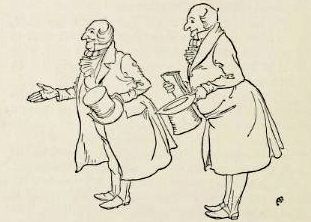
Portly gentlemen, pleasant to behold
"At this festive season of the year, Mr. Scrooge," said the gentleman, taking up a pen, "it is more than usually desirable that we should make some slight provision for the Poor and destitute, who suffer greatly at the present time. Many thousands are in want of common necessaries; hundreds of thousands are in want of common comforts, sir."
Scrooge's response is all too often taken as the response of Victorians generally.
"Are there no prisons?" asked Scrooge.

"Plenty of prisons," said the gentleman, laying down the pen again.

"And the Union workhouses?" demanded Scrooge. "Are they still in operation?"

"They are. Still," returned the gentleman, "I wish I could say they were not."

"The Treadmill and the Poor Law are in full vigour, then?" said Scrooge.

"Both very busy, sir."

"Oh! I was afraid, from what you said at first, that something had occurred to stop them in their useful course," said Scrooge. "I'm very glad to hear it."

"Under the impression that they scarcely furnish Christian cheer of mind or body to the multitude," returned the gentleman, "a few of us are endeavouring to raise a fund to buy the Poor some meat and drink, and means of warmth. We choose this time, because it is a time, of all others, when Want is keenly felt, and Abundance rejoices. What shall I put you down for?"

"Nothing!" Scrooge replied.

"You wish to be anonymous?"

"I wish to be left alone," said Scrooge. "Since you ask me what I wish, gentlemen, that is my answer. I don't make merry myself at Christmas and I can't afford to make idle people merry. I help to support the establishments I have mentioned--they cost enough; and those who are badly off must go there."

"Many can't go there; and many would rather die."

"If they would rather die," said Scrooge, "they had better do it, and decrease the surplus population. Besides--excuse me--I don't know that."

"But you might know it," observed the gentleman.

"It's not my business," Scrooge returned. "It's enough for a man to understand his own business, and not to interfere with other people's. Mine occupies me constantly. Good afternoon, gentlemen!"
Fortunately, attitudes such as Dickens ascribed to Scrooge were the exception rather than the rule. Indeed, in a society where the governing powers did little to aid the poor and what they did was, at best, dubious, help for the poor was likely to come from benevolent organisations set up to assist them including such well known bodies as Barnardo's Homes and the Peabody Trust. There were also many smaller organisations established by local groups and church bodies.

Many of these charitable bodies were, however, aimed at the "deserving" poor, leaving a significant number of those in the lower and labouring classes to suffer the direst poverty. As well, there were some organisations which, like the churches, had their own particular agenda.  During the latter half of the century hundreds of charities sprang up and in 1869 the Charity Organisation Society which was to act as an overarching administrative body was created in London. The COS was in favour of only limited government intervention and supported private charity and particularly the "self help" model espoused by Samuel Smiles in his book of that name.

Among the smaller organisations which sprang up in the latter years of the century, one of the most interesting was the Cinderella Club, founded about 1889, but which took much of its support from the Labour Church movement.  This movement of Christian Socialists was founded by John Trevor in Manchester in 1891 as a reaction to the failure of the more traditional churches to support the working classes. The movement was centred in the industrial North of England and numerous churches seemed to spring up, remain active for a few months, and then cease to exist.  Yet their short-term popularity attracted many.  According to Mark Bevir, "in the first four months of 1894, four new churches spring up in Lancashire alone," and there were probably fifty active churches at the peak of popularity in 1895. By the end of the century, the movement was in decline but one of the legacies that it left was its strong support of Cinderella Clubs.

The idea of the Cinderella Clubs seems to have originated with Robert Blatchford, a journalist with the Sunday Chronicle. According to the Leeds Mercury of 18 April 1890, the Cinderella Club Movement, which was founded in Manchester, aimed "to shed an occasional ray of light and cheer upon the dull lives of the slum children." The Chronicle had "asked for helpers in other towns," and appears to have had little difficulty in securing these from the middle and working classes as well as patrons from the better classes.  In Leeds, for example, the Cinderella Club could count amongst its patrons the Mayor and Lady Mayoress and at least one local Member of Parliament.

Birmingham Cinderella Club Children
The clubs seem to have been run quite independently.  According to the Birmingham Daily Post of 19 December 1890, a Cinderella Club was formed in that city after several citizens of the community had visited Manchester where they had seen one of the Clubs in action.  The Birmingham club was set up to "provide free supper and entertainment once a week to some hundreds of the poorest children in Birmingham." If the report in the paper is to be credited, there can be little doubt of its success. According to that source, the Birmingham club was providing for 350 children each week. Tickets were distributed at schools to children between the ages of 6 and 12 and "the greatest discrimination was exercised" to see that the tickets went only to the very poorest. On the 18th of December, over 1,000 children were fed and entertained at the Birmingham Town Hall.

Cinderella Club boys collecting for the Club
They were admitted in batches, a sufficient number at a time to fill the committee-room.  Each child was served with a metal basin of steaming hot soup, and a spoon with which to eat it.  After they had had their suppers they filed off into the Town Hall, receiving a bun each on the way, and then another detachment took their places.  Supper commenced at six o'clock, and by seven the whole of the children had been fed; but as the last detachment entered the room it was seen that a very large number of cold shivering little ones were at the door without tickets looking wistfully at the more fortunate ones.  That was a pitiable sight, but their hearts were soon cheered and their faced brightened, as they too were allowed to enter, for there was plenty of soup left.

There are numerous descriptions of such benevolence.  Sadly, there was never enough food and drink for all of the needy and there was a continuous process of selection for the dinners.  The success of the Cinderella Clubs cannot detract from the greater failure of the government and the churches in their duty toward those unable to provide for themselves.  Certainly there were those who abused the system, but even the most cursory glance at England in the '90s shows that the children of many in the working class and those who fell below that class, into the "undeserving" poor, were living in bleakest poverty.

A number of studies, including Charles Booth's examination of London in the late '80s and early '90s and Seebohm Rowntree’s study of York at the end of the century, bear out the view that over all poverty levels, at least in those two urban areas were in the range of 25 to 30 per cent. Booth's data determined that in lower-class districts of London, over 30 per cent of the population lived in dire poverty but unlike the common mythology only 15 per cent could be classified (to use the popular terminology) as "undeserving."  The remainder were trapped in a cycle of unemployment, illness and too many children.

The Cinderella Clubs provided some comfort for the children of the very poor but did little or nothing to address the broader issues facing England during a period which saw the great dock strike and other forms of labour unrest.  Undoubtedly, though, their supporters, the "portly gentlemen, pleasant to behold" were able to remaincomplacent in the knowledge that they had done their bit to better the lives of their inferiors.