Monday, December 17, 2012

The Victorian Casual Ward

Luke Fildes, Applicants for Admission to a Casual Ward (1874)
All during Victoria's long reign the streets of  London (not to mention those of the other industrial centres) teemed with the homeless.  Both philanthropy and government services were frequently overwhelmed by the sheer numbers of the needy.  Following the Poor Law Amendment Act of 1834, a uniform public strategy for helping the poor, based on the development of workhouses, emerged but the primary aim of the act was to reduce the poor rates. This was to be accomplished by making the conditions in the workhouses so harsh that the poor would be dissuaded from applying for relief.  This was done by largely adhering to a policy of providing a living standard below that of the poorest labourer.

The grudging benefits of the workhouse system were to be available to those who lived in the Parish. As a result, no aid was available to those who might need very short term help, beggars, tramps, wayfarers and what Victorians referred to as "casuals" or "vagabonds."  By 1837, however, it was apparent that something needed to be done to provide assistance, particularly for those indigent wayfarers from other parishes. The Poor Law Commissioners recommended that this should be provided as short term shelter (usually for a single night) and a meal in return for work.   In addition to the wayfarers, there were those local, urban homeless who were unwilling to go into the workhouse.  This might have been because they valued their freedom or, more probably because conditions in the workhouse were seen as being more onerous than being on the street or even in gaol.  Rather than claim workhouse relief they might take a night's accommodation in a casual ward in order to avoid foul weather or to get the meagre supper that was provided.

Those who sought such short term accommodation were separated from the longer term residents of the workhouse confined to the "casual" wards. According to Norman Longmate, the "standard policy" which was developed to deal with such short term applicants was "to make the vagrant's life so disagreeable that he would hesitate to come back."

After queuing, sometimes for hours, and if there was space available, a casual might be admitted through the single entrance near which were the casual wards. A casual ward might consist of a large room with some bedding and a bucket for sanitation. The bedding was often nothing but straw, with rags for coverings as in the Richmond workhouse in the 1840s. In return for this largesse, the occupant was required to do a set amount of work before leaving on the following day.  Often this work was soul-destroying.  Men might have to spend hours breaking stones while women were set to picking oakum.

Conditions in the casual wards were deliberately designed to discourage vagrants, who were considered potential trouble-makers and probably disease-ridden.

Henry Mayhew, in London Labour and the London Poor (Volume III) described the London casual wards in the middle years of the nineteenth century. On application and admission to the casual ward, a vagrant was provided with a supper of six ounces of bread and an ounce of cheese.  "At one time," according to Mayhew,
every vagrant was searched and bathed, but in the cold season of the year the bathing is discontinued; neither are they searched unless there are grounds for suspecting that they have property secreted upon them.
Men and women were then sent to separate wards where there were two large inclined boards or "guard-beds" on either side of a large room and with a passage down the middle, between these sleeping arrangements.  "The boards are strewn with straw, so that, on entering the place in the day-time, it has the appearance of a well-kept stable." In the morning the casuals were given another meal of bread and cheese and allowed to go on their way.  In some instances they were required to work for three hours to "pay" for their accommodation and the two scant meals with which they were provided.  As Mayhew points out, "the work was demanded as a test of destitution and industry, and not as a matter of compensation." Between 1845 and 1848, the number of those who, on average, spent a night in a Casual Ward grew from 1,791 in England and Wales to 16,086.

The system, which, by any ordinary standard, was tight enough, was tightened even further in 1848 when the President of the Poor Law Board instructed the officers who administered the law to restrict admissions to a far greater degree than had been the case previously.  That this was effective can be seen from the numbers admitted to the Casual Wards in Wandworth and Clapham where from a high of 14,675 admissions in 1848, the number declined to 3,900 in 1849. For Metropolitan London, between 1847-48 and 1848-49, the number relieved fell by almost fifty per cent!

In the half-century following Mayhew's investigation things did not improve much, if at all.  Of course, in addition to the Casual Wards which were operated under the Poor Law Board, there were night refuges.  According to Blanchard Jerrold, in London: A Pilgrimage, published in 1872, bread was distributed to those fortunate enough to gain admission.  Before going to the sleeping dormitories, the vagabonds were required to bathe and this was, for many, an ordeal because of their poor physical condition and poor health.

Bathing in the House of Refuge
 Once they had bathed they went to "the dormitories set out like barracks, and warmed with a stove."  Here there might be a Bible reader walking up and down reading aloud.  Women and children stayed in a separate ward from that of the men. Possibly this was a kinder, gentler environment than that of the Poor Law Casual Wards but when one considers the Casual Ward system as described by General William Booth, in 1890, It is easy to see that the notion of what public social welfare for indigent vagabonds should consist of had changed very little over the half-century.

Scripture Reading in a Night Refuge
The theory of the system is this, that individuals casually poor and out of work, being destitute and without shelter, may upon application receive shelter for the night, supper, and a breakfast, and in return for this, shall perform a task of work, not necessarily in repayment for the relief received, but simply as a test of their willingness to work for their living. The work given is the same as that given to felons in jail, oakum-picking and stone-breaking.

The work, too, is excessive in proportion to what is received. Four pounds of oakum is a great task to an expert and an old hand. To a novice it can only be accomplished with the greatest difficulty, if indeed it can be done at all. It is even in excess of the amount demanded from a criminal in jail. The stone-breaking test is monstrous. Half a ton of stone from any man in return for partially supplying the cravings of hunger is an outrage...
When, a decade later, Jack London attempted to gain entry to a Casual Ward, he found that
the applicant for admission to the casual ward must be destitute, and as he is subjected to a rigorous search, he must really be destitute ; and fourpence, much less four shillings, is sufficient affluence to disqualify him.

At the Whitechapel Workhouse, at just after five in the late afternoon, London found "a long and melancholy line ... which strung out around the corner of the building and out of sight."  "It was," he said, "a most woeful picture, men and women waiting in the cold gray end of the day for a puper's shelter."

One of the most telling descriptions of what it was like to spend a night as a Casual was published in the Pall Mall Gazette in 1866.  James Greenwood and a friend entered Lambeth workhouse for a night in January 1866 where they they remained until the following morning. To download a copy of Greenwood's account, click here.


Wednesday, March 28, 2012

The Cinderella Club Movement


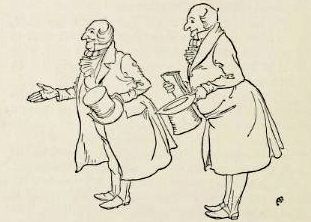
Every reader of Christmas tales is familiar with the wonderful scene in Dickens' A Christmas Carol where two "portly gentlemen, pleasant to behold" enter Ebenezer Scrooge's business premises and seek to get Scrooge's contribution to a fund "to buy the Poor some meat and drink and means of warmth."
Portly gentlemen, pleasant to behold
"At this festive season of the year, Mr. Scrooge," said the gentleman, taking up a pen, "it is more than usually desirable that we should make some slight provision for the Poor and destitute, who suffer greatly at the present time. Many thousands are in want of common necessaries; hundreds of thousands are in want of common comforts, sir."
Scrooge's response is all too often taken as the response of Victorians generally.
"Are there no prisons?" asked Scrooge.

"Plenty of prisons," said the gentleman, laying down the pen again.

"And the Union workhouses?" demanded Scrooge. "Are they still in operation?"

"They are. Still," returned the gentleman, "I wish I could say they were not."

"The Treadmill and the Poor Law are in full vigour, then?" said Scrooge.

"Both very busy, sir."

"Oh! I was afraid, from what you said at first, that something had occurred to stop them in their useful course," said Scrooge. "I'm very glad to hear it."

"Under the impression that they scarcely furnish Christian cheer of mind or body to the multitude," returned the gentleman, "a few of us are endeavouring to raise a fund to buy the Poor some meat and drink, and means of warmth. We choose this time, because it is a time, of all others, when Want is keenly felt, and Abundance rejoices. What shall I put you down for?"

"Nothing!" Scrooge replied.

"You wish to be anonymous?"

"I wish to be left alone," said Scrooge. "Since you ask me what I wish, gentlemen, that is my answer. I don't make merry myself at Christmas and I can't afford to make idle people merry. I help to support the establishments I have mentioned--they cost enough; and those who are badly off must go there."

"Many can't go there; and many would rather die."

"If they would rather die," said Scrooge, "they had better do it, and decrease the surplus population. Besides--excuse me--I don't know that."

"But you might know it," observed the gentleman.

"It's not my business," Scrooge returned. "It's enough for a man to understand his own business, and not to interfere with other people's. Mine occupies me constantly. Good afternoon, gentlemen!"
Fortunately, attitudes such as Dickens ascribed to Scrooge were the exception rather than the rule. Indeed, in a society where the governing powers did little to aid the poor and what they did was, at best, dubious, help for the poor was likely to come from benevolent organisations set up to assist them including such well known bodies as Barnardo's Homes and the Peabody Trust. There were also many smaller organisations established by local groups and church bodies.

Many of these charitable bodies were, however, aimed at the "deserving" poor, leaving a significant number of those in the lower and labouring classes to suffer the direst poverty. As well, there were some organisations which, like the churches, had their own particular agenda.  During the latter half of the century hundreds of charities sprang up and in 1869 the Charity Organisation Society which was to act as an overarching administrative body was created in London. The COS was in favour of only limited government intervention and supported private charity and particularly the "self help" model espoused by Samuel Smiles in his book of that name.

Among the smaller organisations which sprang up in the latter years of the century, one of the most interesting was the Cinderella Club, founded about 1889, but which took much of its support from the Labour Church movement.  This movement of Christian Socialists was founded by John Trevor in Manchester in 1891 as a reaction to the failure of the more traditional churches to support the working classes. The movement was centred in the industrial North of England and numerous churches seemed to spring up, remain active for a few months, and then cease to exist.  Yet their short-term popularity attracted many.  According to Mark Bevir, "in the first four months of 1894, four new churches spring up in Lancashire alone," and there were probably fifty active churches at the peak of popularity in 1895. By the end of the century, the movement was in decline but one of the legacies that it left was its strong support of Cinderella Clubs.

The idea of the Cinderella Clubs seems to have originated with Robert Blatchford, a journalist with the Sunday Chronicle. According to the Leeds Mercury of 18 April 1890, the Cinderella Club Movement, which was founded in Manchester, aimed "to shed an occasional ray of light and cheer upon the dull lives of the slum children." The Chronicle had "asked for helpers in other towns," and appears to have had little difficulty in securing these from the middle and working classes as well as patrons from the better classes.  In Leeds, for example, the Cinderella Club could count amongst its patrons the Mayor and Lady Mayoress and at least one local Member of Parliament.

Birmingham Cinderella Club Children
The clubs seem to have been run quite independently.  According to the Birmingham Daily Post of 19 December 1890, a Cinderella Club was formed in that city after several citizens of the community had visited Manchester where they had seen one of the Clubs in action.  The Birmingham club was set up to "provide free supper and entertainment once a week to some hundreds of the poorest children in Birmingham." If the report in the paper is to be credited, there can be little doubt of its success. According to that source, the Birmingham club was providing for 350 children each week. Tickets were distributed at schools to children between the ages of 6 and 12 and "the greatest discrimination was exercised" to see that the tickets went only to the very poorest. On the 18th of December, over 1,000 children were fed and entertained at the Birmingham Town Hall.

Cinderella Club boys collecting for the Club
They were admitted in batches, a sufficient number at a time to fill the committee-room.  Each child was served with a metal basin of steaming hot soup, and a spoon with which to eat it.  After they had had their suppers they filed off into the Town Hall, receiving a bun each on the way, and then another detachment took their places.  Supper commenced at six o'clock, and by seven the whole of the children had been fed; but as the last detachment entered the room it was seen that a very large number of cold shivering little ones were at the door without tickets looking wistfully at the more fortunate ones.  That was a pitiable sight, but their hearts were soon cheered and their faced brightened, as they too were allowed to enter, for there was plenty of soup left.

There are numerous descriptions of such benevolence.  Sadly, there was never enough food and drink for all of the needy and there was a continuous process of selection for the dinners.  The success of the Cinderella Clubs cannot detract from the greater failure of the government and the churches in their duty toward those unable to provide for themselves.  Certainly there were those who abused the system, but even the most cursory glance at England in the '90s shows that the children of many in the working class and those who fell below that class, into the "undeserving" poor, were living in bleakest poverty.

A number of studies, including Charles Booth's examination of London in the late '80s and early '90s and Seebohm Rowntree’s study of York at the end of the century, bear out the view that over all poverty levels, at least in those two urban areas were in the range of 25 to 30 per cent. Booth's data determined that in lower-class districts of London, over 30 per cent of the population lived in dire poverty but unlike the common mythology only 15 per cent could be classified (to use the popular terminology) as "undeserving."  The remainder were trapped in a cycle of unemployment, illness and too many children.

The Cinderella Clubs provided some comfort for the children of the very poor but did little or nothing to address the broader issues facing England during a period which saw the great dock strike and other forms of labour unrest.  Undoubtedly, though, their supporters, the "portly gentlemen, pleasant to behold" were able to remaincomplacent in the knowledge that they had done their bit to better the lives of their inferiors.

Wednesday, March 14, 2012

Baby Farming

"The darkest, most ghastly shame in the land" wrote the Reverend Benjamin Waugh, Honorary Director of the National Society for the Prevention of Cruelty to Children, in describing baby farming. It was, he went on to say, "a trade which has grown up, and is in full swing in the land—the undertaker for the unwanted baby's death."

 By 1890, when Waugh's tract, Baby Farming was published by the NSPCC, the practice had already gained notoriety as a result of a major investigation carried on by the British Medical Journal more than twenty years earlier, in 1868.  Nor was that the first time the practice had been brought to the attention of the public.  Not infrequently articles appeared in the newspapers of the day citing arrests for baby farming. Unfortunately cases frequently ended in either acquittal or little more than a slap on the wrist for the baby farmer. 

In Oliver Twist, the eponymous hero spends a portion of his youth in a baby farm.  Here, under the watchful eye of Mrs. Mann, he "contrived to exist upon the smallest possible portion of the weakest possible food." Dickens goes on to describe what happened to many of the children thus farmed out.
it did perversely happen in eight and a half cases out of ten, either that it sickened from want and cold, or fell into the fire from neglect, or got half-smothered by accident; in any one of which cases, the miserable little being was usually summoned into another world, and there gathered to the fathers it had never known in this.
. . .
Occasionally, when there was some more than usually interesting inquest upon a parish child who had been overlooked in turning up a bedstead, or inadvertently scalded to death when there happened to be a washing--though the latter accident was very scarce, anything approaching to a washing being of rare occurrence in the farm--the jury would take it into their heads to ask troublesome questions, or the parishioners would rebelliously affix their signatures to a remonstrance.  But these impertinences were speedily checked by the evidence of the surgeon, and the testimony of the beadle; the former of whom had always opened the body and found nothing inside (which was very probable indeed), and the latter of whom invariably swore whatever the parish wanted; which was very self-devotional.  Besides, the board made periodical pilgrimages to the farm, and always sent the beadle the day before, to say they were going.  The children were neat and clean to behold, when they went; and what more would the people have!
Children at the Waters' baby farm

Not all baby farms were as bad as the one Dickens described.  Some were well run and the children were properly cared for, but there were those that were far worse even than the establishment in which Oliver was raised. These were the final stopping place for unwanted children before they were hurried to an untimely death.

Who were the clientele of these nightmare establishments and how did they know to send their unwanted children there? Illegitimacy, particularly amongst the middle-classes of Victorian England, was considered a sin of the blackest sort.  It was, moreover, a sin largely laid upon women.  While there was little that could be done to mitigate a pregnancy, it could be kept as far away from the family and friends of the sinner as possible.  Then, when the baby was born, it could be farmed out and, hopefully, forgotten. It is likely that because of the costs involved in farming a baby out, baby farms were reliant for survival on clients capable of paying to have their unwanted offspring removed as far from the mother as possible. 

Amongst the lower and labouring classes, a baby's antecedents were considered of little importance and rather than pay to have a baby removed, if that was seen as an appropriate course of action, the infant could be dealt with by the parents.  There was, always, the swift flowing Thames as a last resort and final resting place.

For someone looking for a baby farm, the papers advertised them quite blatantly with only the most minimal attempt to "code" the notice.  James Greenwood, in The Seven Curses of London quotes from a number of advertisements for "Adoption." In The Times, there appear, over the Victorian period, numerous notices with headings such as "Child Wanted to Nurse," "Care of child wanted by married couple without children," "The care of a child wanted," etc. Most of these advise that the advertiser is "respectable" and can provide "references."  How many of these were baby-farmers hoping to make some money and how many were legitimate advertisements is difficult to determine.  Certainly, some were likely to be baby-farmers of the worst sort.

Among the most vicious in the trade was Margaret Waters, tried, convicted and sentenced to death at the Old Bailey in September of 1870.  Waters was believed to be responsible for the deaths of as many as nineteen infants. The Times summed up the business in an article published on 12 October 1870.
The wretched woman and her sister were proved to have systematically published advertisements offering to "adopt" children for a remuneration which no one in his senses could believe to be adequate,.  In other words, they offered to the parents of illegitimate children a means of getting rid of charges at once burdensome and shameful to them.
A sergeant of police painted a picture of what he found at the baby farm.  Here  "some half-dozen little infants lay together on a sofa, filthy, starving, and stupefied by  laudanum."

 In the Coroner's court, a fourteen-year old housemaid testified that children at the house had been "taken away at night and not brought back."  She had been told that the children were being taken home.

Disposing of a child

When a post-mortem examination was conducted on one child "the general appearance of the body showed extreme emaciation."  When the Coroner further examined Dr George Puckle who had conducted the post-mortem, the doctor referred to "the extreme wasting and debility to which the child had been subjected," a subject upon which he further expanded at the trial itself.

The charge which Margaret Waters faced in her trial before the Central Criminal Court, the Old Bailey, was the "wilful murder of John Walter Cowen."  John was the illegitimate child of sixteen years old Janet Tassie Cowen.  Janet's father, who seems to have been genuinely concerned with finding a decent home for the child, " answered an advertisement in Lloyd's Newspaper.  The notice to which he responded read:
Adoption.—A respectable couple desire the entire charge of a child to bring up as their own. They are in a position to offer every comfort. Premium required, 4l. Letter only. Mrs. Willis, P.O., Southampton Street, Camberwell.
That such notices where the rule, rather than the exception, was quickly established when Thomas Bassett, a clerk in the advertising department of Lloyd's Weekly Newspaper, during his testimony, produced twenty-seven advertisements from the accused.  When he was asked whether he had received other advertisements of a similar kind, he replied, "Oh yes, for years, from other persons, who professed to take the care of very young children; from a great many different persons."

According to The Times, Waters sold the children "for a fortnight's expenses paid in advance, and would then ... hear no more of them," or she would take them "into the street, placing them in the hands of children and then running away and leaving them to their fate."

In the end, Margaret Waters was found guilty and sentenced to death.  On Tuesday, October 11th, 1870, at Horsemonger Lane Gaol, she became the first woman in England to hang for baby farming.

The Hanging of Margaret Waters
The pictures above are all from the rather sensational paper, The Illustrated Police News.  To see the  transcript of the case, click here. For The Times report of the execution, click here.

Thursday, March 01, 2012

Travelling Menageries

Zoos and menageries were very much in vogue all through Victoria's reign.  For many of her subjects, men and women who would not travel beyond home and village in their lifetime, the animals they were able to see when they were brought to their villages by travelling menageries were both exotic and  remarkable. For the isolated villagers they provided a glimpse of a great and interesting world.

Menageries, of course, pre-dated the Victorian Era.  They were generally maintained by the wealthy and aristocratic in the eighteenth and the early nineteenth centuries. Some idea of the magnitude of  a great private menagerie can be gained by a perusal of the Catalogue for the sale, by auction, in 1851 of the Menagerie and Aviary at Knowsley Hall, near Liverpool.  The menagerie had been formed by the Earl of Derby, President of the Zoological Society of London, and was auctioned upon his death, at which time it consisted of  1,272 birds and 345 mammals. Generally, however, by the time Victoria ascended the throne, private menageries were being replaced by zoological gardens.

Although the "Gardens and Menagerie of the Zoological Society of London" dates from 1828 when it opened as a collection meant for scientific study.  Admissions of the public began  in 1847, around which time it began to be more commonly referred to as the "Zoo."  In 1836, the "Bristol, Clifton and West of England Zoological Society" opened the Bristol Zoo which ranks as the world's oldest provincial zoo.

Zoos, of course, were fixed in place but the travelling menageries could take the show to the people.  And "shows" were exactly what they were despite the very Victorian appeal to the educational verities that such displays might provide. For many in the nineteenth century the travelling menagerie offered the only opportunity they would ever have to see exotic animals. As Judith Flanders has noted in her wonderful book, Consuming Passions, "real animals were educational - no evangelical could 'behold the works of Nature without [also] admiring Nature's God'..."

Some measure of the enthusiasm for wild-life may be garnered from the appeal of the unusual animals that were sold on the London streets in the mid years of the century.  Street sellers were to be found offering all sorts of small animals; mice, birds, ferrets and dogs for sale.  Mayhew lists, among the animals in which the street sellers trafficked, "foreign birds, such as parrots, paroquets, and cockatoos; of gold and silver fish; of goats, tortoises, rabbits, leverets, hedgehogs " as well as "snails, worms, frogs, and toads..."  But, while the street merchants might feed the Londoners' insatiable appetite for the smaller exotic animals, larger creatures could only be viewed in zoos or on those rare visits of a travelling menagerie.

Generally the travelling menageries were to be found at the seasonal fairs in England where they were guaranteed a reasonable crowd. A. E. Housman tells us
The lads in their hundreds to Ludlow come in for the fair,
There's men from the barn and the forge and the mill and the field,
The lads for the girls and the lads for the liquor are there...
Clearly they were there for a good time and, if there was a travelling menagerie, they came to see the big cats and, perhaps, have a ride on an elephant.  The noisy, rumbustious crowd was prepared to make a day of it even if, when the day wore to a close, like Housman's Shropshire Lad they might lament
Oh I have been to Ludlow fair   
And left my necktie God knows where,           
And carried half way home, or near,   
Pints and quarts of Ludlow beer:   
Then the world seemed none so bad,   
And I myself a sterling lad;   
And down in lovely muck I’ve lain,           
Happy till I woke again..
Behind the scenes the animals were spending the greater part of the year travelling over poor roads in all kinds of weather in small cages.  The movement of the menageries must have been a logistical nightmare.  It would involve more than a dozen wagons and scores of horses.  One can only imagine the difficulty of moving an elephant in its wagon on the roads of the day. Thomas Frost, in The Old Showmen and the Old London Fairs points out these difficulties.
It is impossible to do justice to animals which are cooped within the narrow limits of a travelling show, or in any place which does not admit of thorough ventilation.  Apart from the impracticability of allowing sufficient space and a due supply of air, a considerable amount of discomfort to the animals is inseparable from continuous jolting about the country in caravans, and from gthe braying of brass bands and the glare of gas at evening exhibitions.
A Travelling Menageries c. 1856
At the time of his death in 1850, George Wombwell, perhaps the greatest of the Victorian "menagerists" was the proprietor of three travelling menageries. His  brightly painted wagons would arrive with great excitement and the animals would be picketed in the centre of the market square.  A band and spruikers would amuse the crowd and encourage them to pay the 6d or 1s to see even more, inside, where the animals would perform.  There seems to be considerable debate over whether or not there was "overt" cruelty, but even were this not the case, the entirety of the process and conditions of life in a travelling menagerie would have made it a misery for the animals. Nor was safety highly valued. But all that went on behind the scenes.  Thomas Frost described what a visit to see one of Wombwell's shows must have ben like,
I never failed, in my boyhood, to visit Wombwell's, or Atkins's show, whichever visited Croydon Fair, and could never sufficiently admire the gorgeously uniformed bandsmen, whose brazen instruments brayed and blared from noon till night on the exterior platform, and the immense pictures, suspended from lofty poles, of elephants and giraffes, lions and tigers, zebras, boa constrictors, and whatever else was most wonderful in the brute creation, or most susceptible of brilliant colouring.
In March of 1841, Francis Galton, the great Victorian polymath, then only 19 years of age and a student at Trinity College, Cambridge, wrote to his sister, Emma, to tell her that he had actually entered the cage with the animals.
Yesterday I made my appearance before the eyes of wondering Cantabs, where do you think? Why right in the midst of a den containing 1 Lion, 1 Lioness, 1 huge Bengal Tiger and 4 Leopards in Wombwell's menagerie. ... The keeper told me that I was only the fourth that had entered that den.
Clearly Galton was more fortunate than some. In 1834, A lion and a tiger escaped from the menagerie and went on a rampage in the countryside killing a man, a woman and two children.   Wombwell's niece, Ellen Blight, was killed by a tiger when she entered the cage to perform.  Ellen had replaced Nellie Chapman, the original "Lion Queen" with Wombwell's menagerie when Nellie left the show in 1848.

Death of Lion Queen Ellen Blight
As early as 1825, George Wombwell, on two separate occasions, matched lions from his menagerie against fighting dogs.  The matches were highly structured in terms of time and procedure and although Wombwell later was to say that  while there was "talk of cruelty having been practised in the engagement. ... [no]man in his senses [could] suppose that I would risk the loss of my two lions, the finest ever seen in this country, for the purpose of gratifying a cruel propensity."  Perhaps Wombell didn't see it that way, but the correspondent to The Times expressed "disgust and indignation at the cruelty of the spectacle."

While Wombwell was undoubtedly satisfied with the outcome of the match, it is unlikely that the owners of the six dogs would have shared his enthusiasm, considering that those dogs not killed in the second match only barely escaped with their lives. Nor was Wombwell loath to use the fights to advertise his shows.  According to Frost, describing the setup of the menagerie show,
The front was entirely covered with painted show-cloths representing the animals, with the proprietor's name in immense letters above, and the inscription, "The Conquering Lion," very conspicuously displayed.  There were other show-cloths along the whole length of the side, surmounted by this inscription, "Nero and Wallace, the same lions that fought at Warwick."  One of the front show-cloths represented the second fight; a lion stood up, with a bleeding dog in his mouth, and his left fore paw resting upon another dog.  A third dog was in the act of flying at him ferociously, and one, wounded and bleeding, was retreating.  There were seven other show-cloths on this front, with the inscription "Nero and Wallace" between them.
Wombwell made several command appearances before reigning monarchs, three before Queen Victoria including one in 1847.

Wombwell's Menagerie, 1847
The nineteenth century saw vast improvements in the protection of both domestic and wild animals.  This was a process which began shortly before Victoria ascended the throne when, in 1824, the Society for the Prevention of Cruelty to Animals was formed, and culminated, in the year before her death with the passage in 1900 of "An Act for the Prevention of Cruelty to Animals in Captivity." The Royal imprimatur was added to the SPCA by Queen Victoria in 1840. In 1835, bear-baiting and cock-fighting were outlawed and in 1876 a licensing system for animal experimentation was introduced.  But although there were major improvements and an increased concern for the protection of animals, the overall movement was slow, at best.

The 1900 "An Act for the Prevention of Cruelty to Animals in Captivity," began by defining "animal" in the broadest possible sense so as to include "any bird, beast, fish, or reptile which is not included in the Cruelty to Animals Act, 1849 and 1854." It then specified, again in a very broad sense, what was meant by cruelty when it related to captive animals including "unnecessary suffering," as well as any act which might "cruelly abuse, infuriate, tease, or terrify [an animal] ... or permit it to be so treated."

Despite the greater breadth of this Act than those passed earlier, there were still significant omissions.  For one thing, it purposely excluded any application of the Act where an animal was slaughtered for food. It also excluded hunting or coursing although it did specify that this exclusion did not apply where an animal was "liberated in a mutilated or injured state in order to facilitate its capture or destruction."

Such an Act might, however, be a toothless tiger were there not appropriate penalties.  With the 1900 Act, an offence could be prosecuted and the offender could receive, "for every such offence ... imprisonment with or without hard labour for not exceeding three months, or a fine not exceeding five pounds, and, in default of payment, to imprisonment with or without hard labour."

Click here to download Thomas Frost, The Old Showmen and the Old London Fairs.
Click here to download the Catalogue of the Menagerie and Aviary at Knowsley

Tuesday, February 14, 2012

More of the Magnificent Seven

In an earlier blog I wrote about the "Magnificent Seven," the cemeteries created in the 1840s to take pressure off the city of London.  In that blog I only discussed three of the cemeteries.  Here are some brief notes on the remaining four.
 
Abney Park Cemetery

Abney Park Cemetery, one of the "Magnificent Seven," was created in 1840 and was the first completely non-denominational garden cemetery in Europe. For more than 100 years it functioned as a graveyard, only ceasing as a place of burial in the 1970s. Not only was it a non-denominational place of burial, it was unique in combining the cemetery function with an educational arboretum bounded with 2,500 trees and shrubs laid out in alphabetical order. 

Because of its non-denominational origins, Abney Park soon became the favoured place of burial for non-conformists of all persuasions. Here lie the founders of the Salvation Army, William and Catherine Booth, along with their son Bramwell and many others connected to that church. As well it was a favourite resting place for many of the leaders of the Abolition movement. Joanna Vassa, the daughter of Olaudah Equiano an eighteenth century leader for the emancipation of slaves and himself an ex-slave, is buried here.

Among the many fascinating graves to be found here is one, the monument of which features a  magnificent lion.  This marks the grave of Frank Bostock an extraordinary animal trainer of the last years of the nineteenth and the earliest years of the twentieth cemetery.

The "Bostock" Lion

Nunhead Cemetery

Perhaps the least known of the "Seven," Nunhead Cemetery, originally All Saint's Cemetery, was founded by the London Cemetery Company, which also founded Highgate.  With 52 acres of ground, it was the second largest of the Victorian Cemeteries. Consecrated in 1840, it is one of the two cemeteries of the "Magnificent Seven" located south of the river Thames (the other being West Norwood Cemetery).   In 1865, when its first superintendent died, it was discovered that he had managed to mulct the company of eighteen thousand pounds.

In 1851, Tallis's Illustrated London commented, "The grounds are planted with great taste, many of the monuments are extremely beautiful and the chapels have considerable architectural merit."

Gates to Nunhead Cemetery c. 1855

Brompton Cemetery

Near Earl's Court, the Brompton Cemetery was originally known as the West of London and Westminster Cemetery.  Nowadays it is primarily used as a park. The cemetery centred around a domed chapel at one end, with long colonnades leading up to it flanked by catacombs which were seen as a cheaper burial option.

Brompton Cemetery Colonnades

The cemetery has an interesting connection to Beatrix Potter who lived nearby.  She is supposed to have taken many names for her creations from headstones even that of "Peter Rabbett" as it was found on one of the grave markers.  Others were Nutkins, McGregor and Fisher.

Here, too, is buried Fanny Brawne to whom John Keats was engaged and to whom he wrote a series of charming love letter including this one, written in October of 1819 only sixteen months before his death.
25 College Street

My dearest Girl,

Fanny Brawne
    This moment I have set myself to copy some verses out fair.  I cannot proceed with any degree of content.  I must write you a line or two and see if that will assist in dismissing you from my Mind for ever so short a time.  Upon my Soul I can think of nothing else - The time is passed when I had power to advise and warn you again[s]t the unpromising morning of my Life - My love has made me selfish.  I cannot exist without you - I am forgetful of every thing but seeing you again - my Life seems to stop there - I see no further.  You have absorb'd me. I have a sensation at the present moment as though I was dissolving - I should be exquisitely miserable without the hope of soon seeing you.  I should be afraid to separate myself far from you.  My sweet Fanny, will your heart never change?  My love, will it?  I have no limit now to my love - You note came in just here - I cannot be happier away from you - 'T is richer than an Argosy of Pearles.  Do not threat me even in jest. I have been astonished that Men could die Martyrs for religion - I have shudder'd at it - I shudder no more - I could be martyr'd for my Religion - Love is my religion - I could die for that - I could die for you.  My Creed is Love and you are its only tenet - You have ravish'd me away by a Power I cannot resist: and yet I could resist till I saw you; and even since I have seen you I have endeavoured often "to reason against the reasons of my Love."  I can do that no more - the pain would be too great - My Love is selfish - I cannot breathe without you.

    Yours for ever
    John Keats

Others buried here include Henry Cole, the founder of the Victoria and Albert Museum, the Royal Albert Hall, the Royal College of Music, the 1851 Great Exhibition and inventor of the Christmas card; Samuel Smiles, the author of that most Victorian book, Self Help; Samuel Cunard, the founder of the Cunard Line and John Snow who demonstrated the link between cholera and infected water.  Lovers of Cricket too can find in the Brompton Cemetery the grave of John Wisden, a most excellent cricketer who is, however, best remembered as the founder of the eponymous Wisden Cricketers' Almanack in 1864.

Long Wolf
In this most English of cemeteries were buried a number of American Indians. These were the casualties of that great institution, Buffalo Bill's Wild West Show.  Among those who died in England while on tour was  the Lakota Sioux chief, Long Wolf, born in 1833 and one of the warriors who fought in the battle of the Little Big Horn.  Buried with Long Wolf was an infant child, Star Ghost Dog, who died at only 17 months when she fell from her mother's arms while on horseback.  Here too were the graves of Paul Eagle Star, another Sioux and Surrounded by the Enemy, undoubtedly one of the tallest men in the Wild West Show at 6 foot, seven inches who succumbed to a chest infection at the early age of twenty-two. Long Wolf's remains were returned to South Dakota in 1997 and buried in Wolf Creek Community Cemetery at Pine Ridge in that state.

Tower Hamlets Cemetery

This cemetery was opened in 1841 and officially closed in 1966. The Cemetery Company was composed of eleven wealthy directors including the Lord Mayor of the City of London.  Consisting of 27 acres, it was divided into a consecrated part for Church of England burials and an unconsecrated part for all others.

It was the cemetery of the East End and by the turn of the century had a quarter of a million bodies buried in its grounds. Because it was situated in one of the poorest areas of London, a large number of the burials were in public graves which by 1851, ten years after the cemetery opened, house 80% of the deceased.  Public graves often held multiple unrelated bodies and might contain as many as thirty bodies in a pit up to forty feet deep. There was no charge for public graves and they were commonly used by those whose families could afford a funeral, but not the price of a burial plot.

There were, of course, other cemeteries in and around London, and an increasing number as the century moved on.  But the creation of the "Magnificent Seven" stood as a model movement for the cleansing of the unwholesome practices which had caused so much disease in the great Metropolis.

Brompton Park Cemetery Squirrel