Friday, January 20, 2012

"To Die For" Victorian London Cemeteries

Kensal Green Cemetery
Back in June of 2008, I wrote a piece on Victorian Funerals and Mourning.  In it I left the funeral cortege pretty much at the gates of the cemetery; an omission that I want to correct in this blog.  With a rapidly growing population which more than doubled in the first half of the nineteenth century, arrangements for the interment of the dead were totally inadequate.  At least until the 1830s, most burials took place in parish churchyards where the standards of sanitation were often so low that the churchyards were a health hazard to church-goers and to those who had business in the burial fields. Black's Guide to London and its Environs (1870), recalled the situation.

The barbarous practice of interring human bodies within the precincts of the Metropolis has now been wholly abandoned.  But it is only of late years that it has been put down and not before several of the churchyards had become full to overflowing and the neighbourhood had been rendered notoriously unhealthy, "the plague spots of the population." Vaults and catacombs underneath churches have been in most instances closed against the future deposit of coffins therein.  The coffins previously there, if not removed by the relatives of the deceased, have been collected in one common vault which has been closed and built up, never afterwards to be opened on any pretence whatever.
Kensal Green Cemetery with Anglican Chapel

By the 1830s, it was clear something had to be done, but what?  A proposal had been floated, in the 1820s, by the barrister, George Frederick Carden,  to create a commercial cemetery on the outskirts of the great metropolis.  His inspiration was the cemetery of Père-Lachaise, in Paris, which he had visited in 1821.  He could not help but be impressed by the garden atmosphere which surrounded the graves when compared with the squalor of the graveyards in London. Enlisting influential figures in his campaign, a joint stock company was formed and in mid-1831 a tract of 55 acres was purchased at Kensal Green. Here, the first of the great cemeteries of London, the first of "the magnificent seven" as they came to be called in the 1980s, was laid out.  Landscaped and with mausoleums and catacombs, buildings designed in the classical style, it became the final resting place of choice for many of the most prominent men and women of the age.  The first burials took place there in early 1833, and within ten years six more large cemeteries had opened near London: West Norwood Cemetery (1837), Highgate Cemetery (1839), Abney Park Cemetery (1840), Nunhead Cemetery (1840), Brompton Cemetery (1840) and Tower Hamlets Cemetery (1841).

All of the "magnificent seven" cemeteries were privately owned and were established under act of Parliament. Over the years, their popularity rose and fell both as burial sites and as places of interest.  In 1858, for example, Nelsons' Guide to the Environs of London noted that "only Highgate, Kensal Green, and Norwood, are worth visiting."

Kensal Green Cemetery, the oldest of the seven, is still run by the original company which established it. Approximately a quarter of a million individuals are buried there and under the original mandate the existing bodies may not be exhumed and cremated.  Neither can the land be sold for development and once it is full and can no longer function as a burial ground, it is to remain a memorial park in perpetuity. Numerous well-known Victorians are buried in Kensal Green including authors William Makepeace Thackery, Anthony Trollope, Wilkie Collins and Thomas Hood, Actors Fanny Kemble and William Macready and others as diverse as the acrobat and tightrope-walker Charles Blondin, the engineer Isambard Kingdom Brunel and the mathematician Charles Babbage.

G. K. Chesterton, in The Flying Inn, wrote "...that there is good news yet to hear and fine things to be seen, Before we go to Paradise by way of Kensal Green."

West Norwood Cemetery, in the London Borough of Lambeth, is also known as the South Metropolitan Cemetery. Well known for its Gothic Revival architecture, it is on the National Register of Historic Parks and Gardens and is considered one of the significant cemeteries in Europe. Including cremations and those buried in the catacombs, West Norwood is the final resting place for more than 200,000 souls. In the mid-1960s, the local council purchased the cemetery, removing thousands of monuments and restarting burials.  As part of what has been described by the Friends of the West Norwood Cemetery as "desecration," existing plots were even sold for re-use.  It was not until 1995 and 1997 that the council's practices were declared illegal.  Sadly, by then most of the damage had been done and while the council was required to restore some of the monuments, for most it was too late.

Numerous Victorians are to be found in the cemetery.  The founder of the Tate Gallery, Sir Henry Tate lies in West Norwood as does the founder of the Reuters news agency and the co-founder of the P. and O. shipping line.  Here too can be found the remains of Maria Zambaco, artist, model and one of the beauties of the age who modelled for Edward Burne-Jones and appears in his "The Beguiling of Merlin."  Another notable woman lies in this cemetery, Isabella Beeton, famous for her Book of Household Management,who died at the age of twenty-eight.

The Beguiling of Merlin

Another one of the "magnificent seven" is Highgate Cemetery, probably best know as the final resting place of Karl Marx. The cemetery is described in an 1847 poem, "Thoughts on Visiting Highgate Cemetery," in Douglas Jerrold's Shilling Magazine as "A Place of pleasant walks, and grassy slopes,/And girt about with trees ..." The Cemetery was consecrated in May of 1839 and originally consisted of about twenty acres on the side of Highgate Hill facing the metropolis and with a view to the city described in The Penny Magazine of that same year as "remarkably fine and ... alone well worth a visit..."

Part of the design of the cemetery was an "Egyptian" avenue with 32 vaults, each of which had room for twelve coffins. This theme was carried on with the "Circle of Lebanon" which by 1870 had been extended from its original twenty vaults to a total of thirty-six. These, and other features, made Highgate the fashionable cemetery of choice for many. In the 1850s, the cemetery was extended by twenty acres, becoming the "East Cemetery." Here are found the graves of Charles Dickens' parents, his wife and his daughter as well as those of the scientist, Michael Faraday and poet Christina Rossetti. Buried here is Mrs. Henry Wood, the author of East Lynne, the "Napoleon of Crime," Adam Worth and the pugilist, Thomas Sayers.


Tom Sayers' grave with his dog "Lion"
By the middle years of the 1850s, deaths in London exceeded 50,000 per year.  The space required for such a large number of burials would have been about 48 acres. Both Kensal Green and Highgate were becoming crowded and there were problems with some of the other suburban cemeteries.So, while the problem of sanitation had been solved to some extent, the issue of space was still largely unresolved until cremation became more common.

The Crematorium at Woking, Surrey
Although cremation was not illegal in England, and the first working crematorium was built in Woking, Surrey in 1879, it was not widely practised in the nineteenth century.  In 1902, Parliament passed the Cremation Act which formalized the use of the practice and by 1968 more than half of all the dead in Britain were cremated.  Today, that figure stands at around 70 per cent.

For  details as to the interment of the dead prior to the establishment of the great municipal cemeteries, download the Report on the sanitary conditions of the labouring population of Great Britain. A supplementary report on the results of a special inquiry into the practice of interment in towns. Made at the request of Her Majesty's principal secretary of state for the Home department -by clicking here.

Tuesday, January 10, 2012

Women in Cages

Steel Cage Crinoline
 The cage crinoline, or hoop skirt, worn by women through the 1860s was based on a design patented in the 1840s. Although bulky and uncomfortable, it had the advantage of being light in weight and strong enough to support numerous layers of garments. Although worn by women of all social classes, those of the lower and labouring classes who wore it were often the subject of ridicule.

 Not surprisingly it was seen as an attempt to "ape" their betters for, as Thorsten Veblen noted, dress "in order to serve its purpose effectually, should not only be expensive, but it should also make plain to all observers that the wearer is not engaged in any kind of productive labour."  Surely there is little in the way of a woman's dress that would so clearly indicate that she is not engaged in productive labour as the crinoline. A woman's dress, Veblen goes on, "hampers the wearer at every turn and incapacitates her for all useful exertion." It personifies both conspicuous consumption and conspicuous leisure.  Clearly the cost of cloth alone for a crinoline would have been greater than for a smaller outfit.  It thus became an outward sign of one's wealth, or at least of the wealth of one's husband or father. Needless to say, with its great volume, the clothing was conspicuous, and should one fail to notice it at first glance (a highly unlikely scenario) one could hardly fail to notice it when trying to get through a doorway at the same time as a "crinolined" woman or find a seat on an omnibus.

From the mid-1850s, good crinolines were made out of spring steel hoops which were both light and flexible.  They were suspended, one above another, with the smallest at the top  gradually widening towards the bottom.  These devices could be made up of from as few as nine hoops to the larger and much more formal outfit consisting of up to eighteen circles of steel. Spring steel was particularly useful since it could be pressed out of shape temporarily, making it easier for the wearer of the garment (which at its widest could be up to six feet across) to get through doors, sit down, and enter and exit vehicles.

By the 1850s, even the Illustrated London News was complaining that it was impossible to sit on an omnibus with women in crinolines which, it commented, transformed a woman into a "walking bale of goods." Certainly, the crinoline was the cause of much humorous vexation amongst gentlemen.  A writer to The Times in January of 1857,signing himself "A respectable elderly gentleman" complained,

Often, Sir, at ball or crowded assembly have I been gripped by the confluence of massive tissues.  Often have I been suddenly and painfully compressed in a doorway by the framework of a creature whom nature had intended for a fairy. Nay, Sir, more than once have I, without a murmur, submitted during a pelting rain to banishment from my own carriage, constructed originally for the conveyance of four persons, but now, forsooth, not capable of one elderly and two youthful ladies, hedged in their shells like the clapper of a bell.

In addition to the crinoline itself, and its covering, a woman would commonly wear drawers.  The risk of falling or having one's dress caught by the wind could mean exposure not merely to the elements, but to the view of men and women nearby.


Even walking up stairs might have considerable potential for embarrassment. Drawers commonly came to below the knees and were considered the most intimate garment that women wore. They were often gathered at the bottom and helped in the retention of modesty for those wearing a crinoline.  Petticoats were also worn.  Generally the minimum would be one underneath the crinoline and one outside it to soften the look of the metal hoops.

Naturally, much fun was made of the latest fashion in women's clothing. In a story in Blackwood's Edinburgh Magazine for November 1856, the author points out that the modern woman requires "three clear feet of ground on either side for the unruffled expansion on the "crinoline," round whose hem the worshipper must stand at reverential distance, and shout his soft inanities into the far-off ear of his divinity." Again, in 1863 the same journal published a poem, "Crinoliniana," which ended,

I long to clasp thee to my heart
     But all my longings are in vain;
I sit and sigh two yards apart,
     And curse the barriers of thy train.
My fondest hopes I must resign,
I can't get past that Crinoline!

Ragamuffins in the street would shout after women in crinolines, "who's your cooper," and even Charles Babbage, the noted English mathematician and inventor of the difference machine, a fore-runner of the modern computer, was dragged into the discussion. In a humorous note, in October of 1862, "Tickler" a regular contributor to the Edinburgh Magazine, refers to "those arid acres of crinoline, which Mr Babbage has calculated wuld cover, on to the thirty-second of last month, no less a surface than thirty miles six furlongs and a perch and a-half!"

Young Mr Punch, by now in his adolescence, could hardly refrain from commenting.  Numerous cartoons appeared during the 1850s and '60s, and even those that were not directly aimed at the crinoline would often feature women wearing outsized hoop skirts or, as only Punch could do, would take the idea of the hoop skirt and apply it to other uses as in the anti-garotting cartoon to the left.


On a more serious note, the wide expanse of the crinoline, and the use of open flames in heating and lighting, meant that the risk of serious, if not fatal, injury was increased.  In December 1858, the Liverpool Mercury reported the death of Lady Lucy Bridgman who had fatally burned herself while trying to extinguish the burning dress of her sister.  As well as the death of the two sisters, men of the family were burnt when they attempted to save the sisters.  Commenting on this, T.M.S., writing to The Times describes how his wife's dress caught fire which, fortunately, he was able to extinguish.  But, he asks, "When will this dangerous style of dress be done away with?"

What was it, then, that made the crinoline so popular?  The crinoline, prior to the use of spring steel had been relatively common, although significantly smaller in area and heavier in weight.  With the ability to lighten the load on the wearer, it expanded (both literally and metaphorically) to meet, in England, the dictates of Paris fashion.  It was, too, a way in which a woman was distanced, both physically and psychologically, from her surroundings, from the real world, and kept safe for her husband or father.  In a sense it was the real-life equivalent of placing herself on the pedestal.


 Finally, it conformed well to the principles of conspicuous consumption and conspicuous leisure mentioned above.  Not only was it a wasteful use of material, the cost of cleaning the clothing worn over the hoop and the effort involved in doing so would have been great.  The fact that the wearer of such an outfit could do little more than stand or sit and would have been largely incapacitated from doing anything useful made it an ideal image for conspicuous leisure.

For a history of the corset and the crinoline, click here.

Wednesday, November 09, 2011

To Kill the Queen, Part II

In addition to the attempts, serious and otherwise, made on the life of Victoria, there were numerous instances of what John Ashton, in Gossip in the first decade of Victoria's reign, refers to as her being "somewhat pestered with lunatics." John Castell Hopkins notes that

the Queen was worried by a number of more or less crazed individuals who would have liked to share her greatness.  This mania to marry the young Sovereign took various forms.  One man used to drive his phaeton in front of, or behind, the royal carriage whenever an opportunity offered, and make a nuisance of himself by waving or kissing his hand to Her Majesty.  Another lunatic went through a sort of dumb show of the same kind in the Chapel Royal, while a commercial traveller, named Willets, galloped alongside the Queen’s carriage, and almost over her attendants, in his mad desire to reveal the state of what he might have termed his heart. These men were dealt with in ways best suited for the disposal of harmless monomaniacs.

Two examples of this behaviour should suffice.  Captain John Goode had, on the 24th of May, 1837, been taken into custody for "creating a disturbance and forcibly entering within the enclosure of Kensington Palace" on the Queen's birthday.  Less than six months later, on 4 November, as the Queen was returning from Brighton, Goode came up to her carriage and "made use of most insulting language towards Her Majesty and the Duchess of Kent.  Goode was a gentleman with a large property in Devonshire and was apparently quite mad.  When he was examined before the Privy Council, he told them "that, if he could but get hold of the Queen, he would tear her in pieces."  After a short period of imprisonment, he was sent to a lunatic asylum.

The most interesting case of a lunatic pestering the Queen was that of “The Boy Jones” as he was commonly known.  On Thursday, 25 March 1841, Thomas Raikes wrote in his Journal,

A little scamp of an apothecary’s errand-boy, named Jones, has the unaccountable mania of sneaking privately into Buckingham Palace, where he is found secreted at night under a sofa, or some other hiding-place.  No one can divine his object, but twice he has been detected and conveyed to the Police-office, and put into confinement for a time.  The other day he was detected in a third attempt, with apparently as little object.

A highly fictionalized version of the story was made into the 1950 film The Mudlark with Irene Dunne, Alec Guiness and Andrew Ray.

From 1849, the attacks against the Queen seem to have become more serious.  In that year William Hamilton fired a powder-filled pistol at Victoria's carriage as it drove down Constitution Hill, London.  She appears, from her correspondence, not to have been overly alarmed, writing to her uncle Leopold to assure him that it was nothing more than "a wanton and wicked wish merely to frighten," although she did view it as "very wrong." Once again, much to Victoria’s delight, the people rallied around her. "The indignation, loyalty, and affection this act has called forth is," she wrote, "very gratifying and touching."

On the evening of 27 June 1850, in what The Illustrated London News referred to as an "atrocious" and "most diabolical act," there was a more serious assault on the Queen. In what seemed to be a senseless attack, a tall, respectable looking, balding man with a mustache, ex army officer, Robert Pate, struck Victoria on the cheek and in the forehead with the brass ferule of a partridge stick as she was leaving Cambridge house with three of her children.  She had called to inquire about the Duke, her uncle’s failing health.

Robert Pate Attacking the Queen

In her letters she described the incident as "very disgraceful and very inconceivable" and it left her bruised, if not bloodied. Even so, later in the evening she attended the Covent Garden Italian Opera to see Meyerbeer’s, Le prophète, where she was given a rapturous welcome. But the attacks were beginning to take a toll on the Queen who admitted to being nervous when she was out in her carriage confessing in a letter to the King of the Belgians, "I start at any person coming near the carriage." 

Pate was tried in the Central Criminal Court, and despite a catalogue of “eccentricities” was found sane and guilty and was sentenced to seven years transportation which he served in Van Diemen’s Land.

On the last day of February 1872, the Queen was being driven in an open landau when 17-year-old Arthur O'Connor (great-nephew of Irish MP Feargus O'Connor) appeared at the side of the carriage as it stopped.  In her journal, Victoria described the event and was much more open regarding her feelings than in her letters to her uncle in which she described the earlier attempts.
     
 It is difficult for me to describe, as my impression was a great fright, and all was over in a minute. ... suddenly someone appeared at my side, whem I at first imagined was a footman, going to lift off the wrapper.  Then I perceived that it was someone unknown, peering above the carriage door, with an uplifted hand and a strange voice. ... Involuntarily, in a terrible fright, I threw myself over Jane C[hurchill]., calling out, ‘Save me,’ and heard a scuffle and voices!

John Brown, who was attending the Queen, grabbed O’Connor and he was arrested and  brought before the Court on 2 April at which time he pleaded guilty to the charge of treason.  Although an attempt was made to declare him insane, a jury later found "that the prisoner was perfectly sane when he pleaded guilty to the indictment and perfectly sane now." He was sentenced to a years' imprisonment and twenty strokes with a birch rod. The latter was remitted.

Apparently, O’Connor suffered from some degree of mental disorder and this probably accounted for his relatively light sentence.  It appeared that his attempt to reach the Queen was to petition her for freedom for a number of Fenian prisoners.

The final attempt on Victoria’s life was, once again, the work of an apparent lunatic.  On 2 March 1882, as her carriage left Windsor railway station for the castle, a "wretchedly clad man" fired a pistol at the Queen from a distance of approximately 30 yards.  The assailant was Roderick Maclean, a disgruntled poet, apparently offended by what he saw as Victoria's refusal to acknowledge one of his poems. As he was hustled away by police, schoolboys Gordon Chesney Wilson and Leslie Murray Robinson, from Eton College belaboured him over the head and shoulders with their umbrellas. Not all of their exertions were, however, strictly on target.  William John M’Closkie, the Landlord of the Star and Garter, told the Board of Magistrates convened at Windsor that in the melee that followed the apprehension of Maclean, "I was hit over the head with an umbrella, the blow being intended for the prisoner."

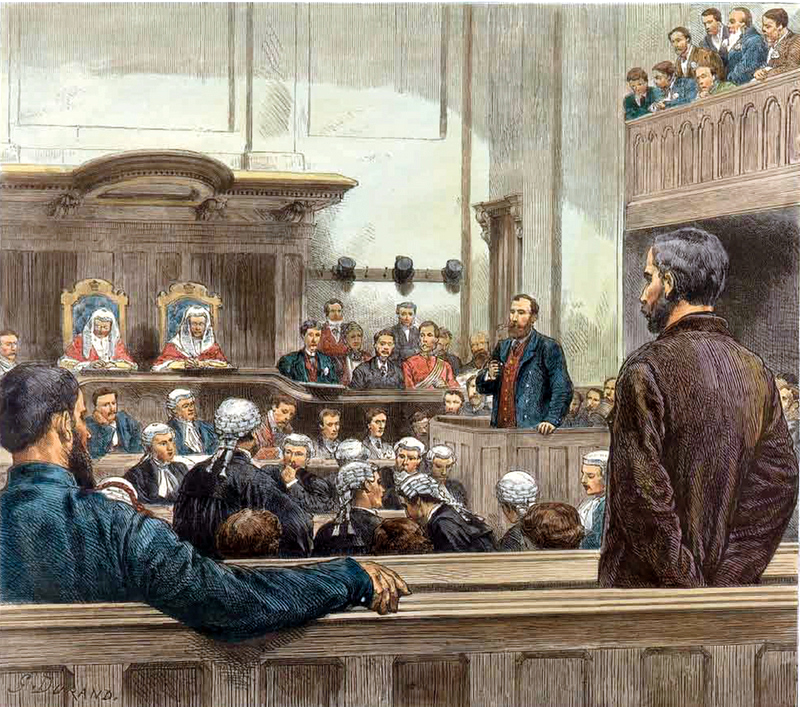
Maclean on trial for treason
In fact, the receipt of his poem had been acknowledged.  Shortly after having left one of his places of residence, a letter arrived from the palace in which Lady Elizabeth Biddulph returned Maclean’s verses noting that "the Queen never accepts manuscript poetry."

Despite Mclean’s insistence that his only intention was to frighten the Queen, all of the evidence suggested that there was more to the attempt than that.  The finding of bullets apparently from the gun McLean used seemed to remove any question of his having only fired blank cartridges.

The crowned heads of Europe which, by this time were resting increasingly uneasily, sent their congratulations to Victoria on having survived the attack.  Churches offered prayers of thanksgiving for her life having been spared even while Maclean was bound over to be tried for high treason at the Berks Assizes on 19 April 1882. 

It was clear both before, during and after the trial that Maclean suffered from a significant mental disorder. The Professor of psychology at King’s College and Medical Superintendent at Colney Hatch Lunatic Asylum for twenty years, testified that Maclean was "unquestionably of unsound mind." An opinion concurred in by a number of other witnesses.

In the end it took a jury only twenty minutes of acquit Maclean on grounds of insanity, knowing, from The Lord Chief Justice’s charge, that if they were to so acquit him he would be "safely detained during the Queen’s pleasure."

The ultimate word, on this final attempt to assassinate the Queen, must go to William Topaz McGonagall, considered by many to be the worst poet in the history of that genre.  To read his poem, "Attempted Assassination of the Queen," click here.

Tuesday, August 02, 2011

To Kill the Queen

During Victoria's long reign there were seven "incidents" which might be considered assassination attempts.  In reality, most of these were clearly not serious attempts on her life.  Rather they appear to have been aimed at bringing either an individual or a cause into public prominence.  The first attempt took place on the early evening of 10 June 1840.

Edward Oxford attempts to kill the Queen

It must have been a terrible and frightening occasion when 18-year-old Edward Oxford attempted to kill the four months pregnant, 21 year old, Queen while she was riding in an open carriage with Prince Albert. Oxford fired twice, but either he missed or the guns were loaded with powder but without bullets.

Victoria was not so naive as to be unaware that there was a deep well of discontent and disaffection amongst her subjects.  Her marriage to Albert had not met with universal favour and her personal popularity had been eroded by the Flora Hastings affair.

Lady Flora Hastings

Lady Flora Elizabeth Rawdon-Hastings was lady-in-waiting to Queen Victoria's mother, the Duchess of Kent.  When Flora noticed swelling and pain in her abdomen she visited the Queen's physician, Sir James Clark.  But when she refused an internal examination, he concluded that she was pregnant. Rumours abounded that the alleged father was John Conroy, a favorite and possible lover of the Queen's mother, the Duchess of Kent.  Victoria despised Conroy and, for this reason, was probably more easily convinced of Lady Flora's pregnancy.

In the end, after a physical examination, it was established that the cause of the swelling was not pregnancy but a cancerous tumour on Flora's liver.  She died in July of 1839, only thirty-three years of age. Conroy and Flora's brother, Lord Hastings, launched a virulent campaign which did nothing to enhance the popularity of the Queen.

But immediately after the assassination attempt, as Charles Greville notes in his memoirs, The Queen "appeared perfectly cool, and not the least alarmed." After visiting her mother to tell her of the event, "she continued her drive."

By this time the attempt upon her life had become generally known, and she was received with the utmost enthusiasm by the immense crowd that was congregated in carriages, on horseback, and on foot. All the equestrians formed themselves into an escort, and attended her back to the Palace, cheering vehemently, while she acknowledged, with great appearance of feeling, these loyal manifestations. She behaved on this occasion with perfect courage and self-possession, and exceeding propriety; and the assembled multitude, being a high-class mob, evinced a lively and spontaneous feeling for her—a depth of interest which, however natural under such circumstances, must be very gratifying to her, and was satisfactory to witness.

Oxford was tried for high treason and found guilty, but was acquitted on the grounds of insanity. In the immediate aftermath of the attack, Victoria's popularity soared, mitigating residual discontent over the Hastings affair and the bedchamber crisis. The government, too, rallied with the Foreign Secretary, Viscount Palmerston writing to the Queen the day after the event to congratulate her on her escape and to "express the horror with which he heard of the diabolical attempt and the deep thankfulness which he feels at your Majesty's providential preservation." The Prime Minister wrote to the Queen to express his feelings, calling it "a most awful and providential escape,"  going on to add that it was "impossible not to shudder at the thought of it."  Her beloved Uncle Leopold, King of the Belgians, suggested that one would think that Victoria, "being a lady would alone prevent such unmanly conduct," but he goes on to blame it, at least in part, on the press and the influence of the French! 

Just under two years after Oxford's attempt on her life, On 29 May 1842, Victoria was riding in a carriage, returning from chapel, when, as she reports,"Albert was observing how civil the people were, and then suddenly turned to me and said it appeared to him as though a man had held out a pistol to the carriage, and that it had hung fire."

The assailant was John Francis.

John Francis fires on the Queen


The following day, Victoria drove the same route, though faster and with a greater escort, in a deliberate attempt to provoke Francis to take a second aim and catch him in the act.  Greville thought that it "was very brave, but imprudent," and that "it would have been better to ... have let the police look for the man." As expected, Francis shot at her, but he was seized by plain clothes policemen, and convicted of high treason. Musing on the matter Greville commented that

it is certainly very extraordinary, for there is no semblance of insanity in the assassin, and no apparent motive or reason for the crime.  The young Queen, who is an object of interest, and has made no enemies has twice had attempts made on her life within two years.

and the Queen dismissed him, in a letter to her uncle, as mauvais sujet.

On 3 July, two days after Francis' death sentence was commuted to transportation for life, John William Bean also fired a pistol at the Queen.  Despite some feeling that the granting of mercy to Francis might have encouraged Bean, Lord Melbourne, writing to Her Majesty, disagreed.

Lord Melbourne is not of opinion that the extension of mercy to Francis which from what Lord Melbourne hears of the opinion of the judges he apprehends to have been unavoidable could have had any effect in encouraging this man to a similar act ; at the same time it is impossible to say what may have had an effect upon the mind, and we can only collect the intentions of men from the deeds which they perform.

According to The Times' report of Bean's trial, the pistol was only loaded with paper, a bit of gravel and a small piece of pipe. In passing sentence, the court told Bean,

 you have been convicted by a jury of your country of an attempt to harass, vex, and grieve your Sovereign, her Majesty the Queen, and to create alarm amongst, and to disturb the peace of, Her Majesty's faithful subjects, by presenting a pistol loaded with powder and wadding at the carriage in which she was seated, and with attempting to cause that pistol to explode.

Bean was sentenced to 18 months in jail.

Melbourne, always aware of the failings he perceived in the lower and labouring classes,  saw the attacks as "evidence of the ease with which persons of the lower orders can incite themselves, or be incited by others to the contemplation and commission of such acts."

Perhaps public response to the attempts was enough to cause them to stop, at least for a few years, for it was not until 1849 that another attack was made on the life of the Queen and that was to be followed by a fifth attempt only a year later.

To read a contemporary account, in The Illustrated London News, of John Francis' attempt on the life of the Queen, click here.

(To be continued)

Thursday, March 24, 2011

A short visit - General Tom Thumb calls on the Queen

General Tom Thumb (Picture courtesy of Paul Frecker, London)

On the 20th of February 1844, an advertisement appeared in The Times announcing the appearance of General Tom Thumb at the Princess’s Theatre in Oxford Street. He, his family and his mentor and manager, Phineas T. Barnum had left New York a month earlier aboard the "Yorkshire" bound for Liverpool, and after a short season there had proceeded to London where Thumb appeared for several days at the Princess's theatre. Barnum saw the short engagement as a way of "advertising" his youthful protégé.

Barnum and Tom Thumb
The day following his first London appearance, The Times waxed lyrical, describing him as “the most minute specimen of walking and talking humanity it is possible to conceive”.  Although Thumb was only five years old at the time, the review notes that “he stated his age to be 12 years.” At the time he was 25 inches tall and weighed 15 pounds; a height and weight he maintained from the time he was seven months old until early adulthood.  Barnum made it a point always to exaggerate the little man’s age in order to make his appearance seem more dramatic.

On the stage, Thumb sang, danced, mimicked, and answered questions put to him (mostly by Barnum). Barnum rented a furnished mansion in the West End and invited members of the nobility to see his ward. Barnum, of course, was a consummate showman and made sure that young Charles Sherwood Stratton, whom he had “re-badged” as General Tom Thumb was kept in the eye of the British public.


Barnum training Tom Thumb
Shortly after their arrival, the Baroness Rothschild sent a carriage for Barnum and "the General."  Barnum described the reception they received.

We were received by a half a dozen servants, and were ushered up a broad flight of marble stairs to the drawing-room, where we met the Baroness and a part of twenty or more ladies and gentlemen.  In this sumptous [sic] mansion of the richest banker in the world, we spent about two hours, and when we took our leave a well-filled purse was quietly slipped into my hand.  The golden shower had begun to fall.

The "Egyptian Hall" in Piccadilly was engaged for appearances by "the General," and the show was a great success.

The reviews were generally favourable and it was not long before General Tom Thumb was invited to attend the Queen at Buckingham Palace. Here, on Saturday evening, the 23rd of March 1844, according to the Court Circular, he, accompanied by Barnum, “exhibited his clever imitations of Napoleon, &c., which elicited the approbation of her Majesty and the Royal circle.” The "meeting" took place in the Queen's picture gallery where "the General" appeared before the Queen, Prince Albert, the Duchess of Kent and "twenty or thirty of the nobility." According to Barnum, "The Queen ... took him [Thumb] by the hand, [and] led him about the gallery."

When the evening came to an end, Barnum and his protégé began the process of backing out of the Queen's presence.  Thumb, because of his size and the shortness of his legs,

found he was losing ground, [so] he turned around a ran a few steps, then resumed the position of 'backing out,' then turned around and ran, and continued to alternate his methods of getting to the door, until the gallery fairly rang with the merriment of the royal spectators.

One of the spectators was not impressed.  The Queen's favority poodle started barking and the General was forced to defend himself with his cane.  Much hilariaty ensued and

Tom Thumb and the Queen's Poodle
one of the Queen's attendants came ... [out] with the expressed home of Her Majesty, that the General had sustained no damage -- to which the Lord in Waiting playfully added, that in case of injury to so renowned a personage, he should fear a declaration of war by the United States!

A few days later, again accompanied by Barnum, the young performer,  appeared at Marlborough House before the Queen Dowager who “was graciously pleased to express her approbation.”  On the 1st of April, Thumb was again at Buckingham Palace and again on the 19th of April. 

Just two months later, William Cavendish the 6th Duke of Devonshire, attended General Tom Thumb at the Egyptian Hall where he “presented him with a magnificent gold snuff box, engraved with beautiful devices, brilliantly mounted with turquoise, and bearing the General’s initials on the top.”

What was the appeal of General Tom Thumb? There would appear to be two facets to the fascination he seemed to exercise. First, there was the ongoing flirtation of the British with what were commonly known as “freaks.” Travelling shows with all sorts of human and animal oddities were common from well before the Victorian Era. Bearded women, giants, midgets, Siamese Twins and mermaids were all a part of the make-up of these perambulating exhibitions. In addition to the desire to see strange creatures, there was the appeal of the foreign. In fact, in the United States, General Tom Thumb who was clearly American, was paraded as English whereas in England he quickly became a “Yankee” wonder.

But the most significant factor in the success of the tour was Barnum’s entrepreneurial ability Barnum was a showman and he knew how to capture the peoples’ interest. On the occasion of his visit to Buckingham Palace, Barnum posted a sign on the door of the Egyptian Hall which read, “Closed this evening, General Tom Thumb being at Buckingham Palace by command of Her Majesty.” 

On December 24th, a letter appeared in The Times in which the writer complained that traffic had been disrupted because Tom Thumb was “being slowly drawn along in a little carriage.”  The carriage, which Barnum had built for him, was “drawn by miniature horses and attended by children dressed in livery.”

That he remained popular with the British public is attested to by an article in The Morning Chronicle which, when he returned to England in the mid-1850s, welcomed him as a “lively, debonnaire little gentleman.”

To gain some sense of the General's height, click here.